Why Your Phone Knows What You’re Thinking About
Your phone doesn’t actually read your mind, but modern algorithms are incredibly good at predicting your behavior. This blog explores how apps, AI systems, tracking data, and recommendation engines make smartphones feel almost psychic.

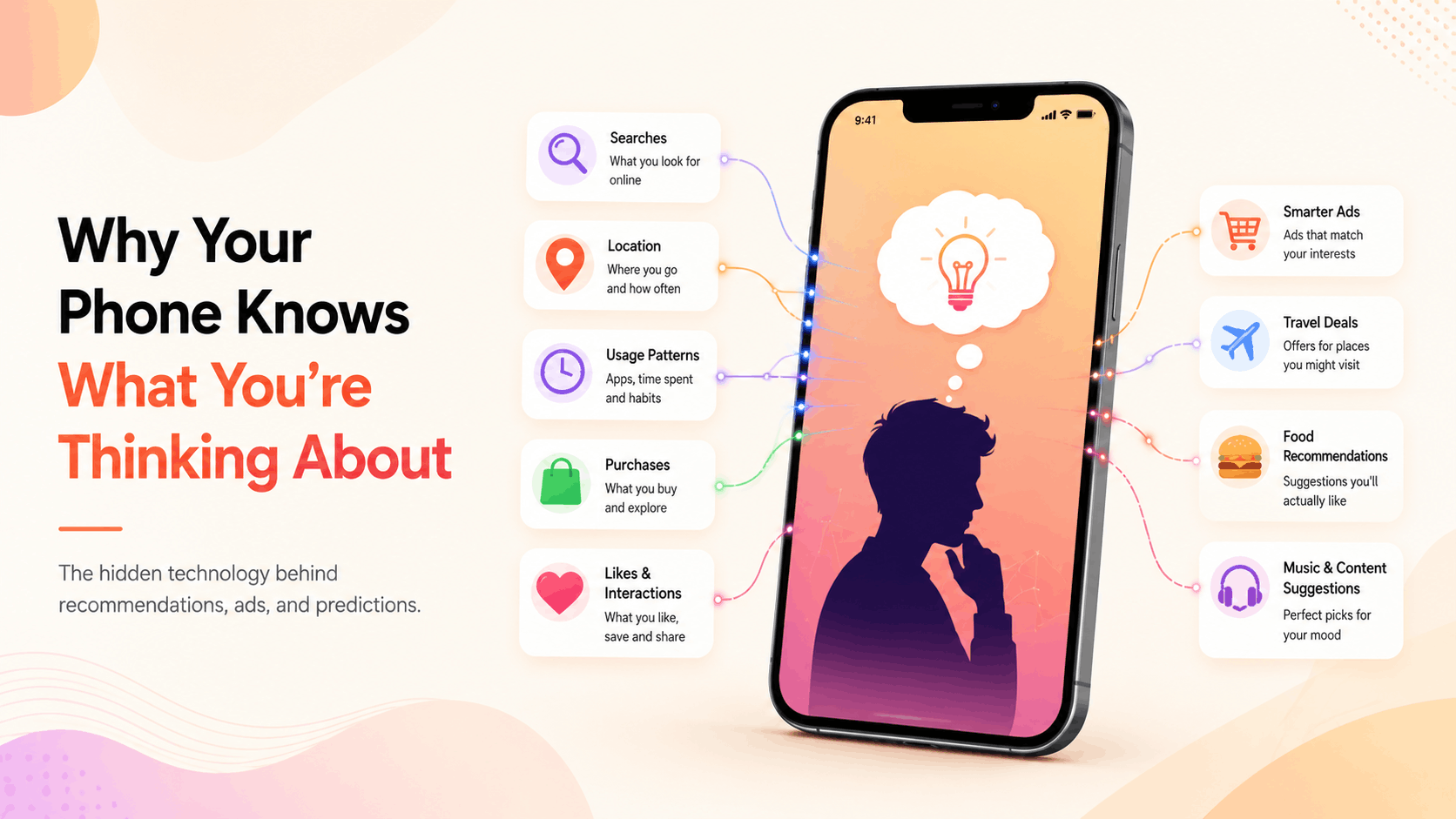
The hidden world of algorithms, tracking systems, recommendation engines, and behavioral prediction quietly shaping your digital life
Introduction: The Creepy Coincidence Everyone Experiences
You casually think about buying shoes.
A few hours later:
Shoe ads appear everywhere.
You mention traveling once…
Suddenly:
- Instagram shows travel reels
- YouTube recommends flight hacks
- shopping apps push luggage ads
At some point, almost everyone has the same thought:
“Is my phone listening to me?”
Honestly?
That question became one of the internet’s most famous modern fears.
Because modern smartphones sometimes feel uncomfortably accurate.
Almost psychic.
Like your device somehow knows:
- what you want
- what you’re interested in
- what you’re likely to buy
- what you might click next
And sometimes…
What you might even think about soon.
So naturally, people assume the following:
“Phones must be secretly listening.”
But the truth is actually far more interesting.
And honestly?
A little more disturbing.
Because in most cases,
Your phone doesn’t need to hear your conversations.
Modern algorithms are already extremely good at predicting human behavior using:
- patterns
- habits
- clicks
- searches
- locations
- interactions
- attention signals
Your phone often appears to be mind-reading not because it’s magical…
But because modern technology became incredibly good at understanding patterns humans don’t even notice themselves.
Your Phone Is Constantly Collecting Signals
Every day, your smartphone quietly generates enormous amounts of behavioral information.
Not just:
- searches
- messages
- social media posts
But also tiny invisible signals like
- how long you pause on videos
- what you scroll past slowly
- what you ignore
- where you travel
- what time you open apps
- how often you shop
- which posts hold attention
Individually,
These signals seem meaningless.
Together?
They become incredibly predictive.
The Most Important Thing to Understand
Your phone does not need to know everything about you.
It only needs enough data to predict behavior accurately.
And humans are surprisingly predictable.
That’s the uncomfortable part.
Why the “Phone Is Listening” Theory Became Popular
Because sometimes ad targeting feels absurdly accurate.
For example:
You discuss coffee machines with a friend…
Then coffee ads appear later.
That coincidence feels suspicious.
But in many cases,
The explanation is more complex than secret microphone spying.
Your Digital Life Already Reveals More Than You Realize
Think about how many systems already know:
- your location
- search history
- shopping habits
- video interests
- app usage
- browsing behavior
- online activity
Modern algorithms combine these signals together.
The result feels almost supernatural.
But it’s mostly prediction.
Algorithms Became Extremely Good at Pattern Recognition
Modern recommendation systems analyze billions of behavioral interactions daily.
Platforms study:
- what users click
- what users watch
- how long attention lasts
- which topics correlate together
Over time,
Algorithms become surprisingly effective at predicting future interests.
Example: How the Prediction Actually Happens
Imagine this scenario.
John:
- recently searched fitness videos
- watched healthy recipe content
- followed gym creators
- checked protein supplement prices
- visited sportswear websites
Even without directly searching:
“running shoes”
Algorithms may already predict:
John is likely interested in fitness products.
So shoe ads appear.
From a user perspective:
It feels psychic.
From an algorithm perspective:
It's probability.
Recommendation Systems Quietly Shape Most of the Internet
Platforms like:
- TikTok
- YouTube
Depend heavily on recommendation engines.
Their goal is simple:
keep users engaged longer.
To do that,
systems must predict:
what users are likely to enjoy next.
Your Attention Became Data
Every second you spend looking at something teaches algorithms something.
Even tiny behaviors matter.
For example:
- pausing longer on a post
- rewatching video
- stopping scroll briefly
- hovering over product
These signals become training data.
And modern AI systems consume enormous amounts of it.
The Internet Is Quietly Building Behavioral Models
This is where things become fascinating.
Modern platforms increasingly create behavioral profiles.
Not necessarily personal profiles like:
“John likes pizza.”
But deeper probabilistic models like:
“Users with these behaviors often become interested in X.”
The systems think statistically.
Your Friends Influence Your Recommendations, Too
Algorithms don’t analyze you alone.
They analyze networks.
If:
- your friends search something
- people near you buy products
- users with similar behavior engage with content
Recommendations may shift accordingly.
Behavior spreads socially online.
Location Data Is More Powerful Than Most People Realize
Your phone constantly interacts with location systems.
Apps may know:
- where you shop
- which restaurants you visit
- commuting patterns
- travel routines
The location itself becomes predictive data.
For example:
Visiting malls frequently may increase retail-related recommendations.
Your Smartphone Is Basically a Sensor Machine
Modern phones contain:
- GPS
- accelerometers
- microphones
- cameras
- gyroscopes
- Bluetooth systems
- Wi-Fi tracking
These sensors help apps create richer user experiences.
But they also generate enormous behavioral information.
Is Your Phone Actually Listening?
Technically:
Apps can access microphones with permission.
But constantly recording and processing billions of users continuously would be:
- expensive
- battery-draining
- legally dangerous
- technically inefficient
In most cases,
Behavioral prediction is already accurate enough without constant audio spying.
That’s the important part.
The Creepy Truth Is Actually Simpler
Your phone often seems psychic because:
Modern systems understand human behavior extremely well.
Sometimes better than humans understand themselves.
That’s what feels unsettling.
AI Made Prediction Even More Powerful
Artificial intelligence dramatically improved recommendation systems.
Modern AI models analyze the following:
- patterns
- correlations
- probabilities
- behavioral similarities
At a massive scale.
The result:
hyper-personalized digital experiences.
Why Social Media Feels Addictive
Because platforms continuously optimize around:
- engagement
- attention
- emotional reactions
- retention
Algorithms constantly learn:
What keeps users scrolling?
Then show more of it.
Infinite Scrolling Supercharged Data Collection
Every scroll creates more behavioral data.
The longer users stay:
the smarter recommendation systems become.
This creates powerful feedback loops.
More usage → better predictions → more engagement.
Search Engines Quietly Predict Thoughts Too
Modern search systems often autocomplete thoughts before users finish typing.
That’s because systems analyze:
- trending searches
- historical behavior
- language patterns
Prediction became deeply integrated into modern interfaces.
Why Two People See Completely Different Internet Feeds
Your internet is increasingly personalized.
Two people opening the same app may see completely different things:
- posts
- videos
- advertisements
- recommendations
Algorithms customize experiences based on behavioral predictions.
The internet became individualized.
Data Brokers Quietly Expand the System
One hidden layer many users never think about:
data ecosystems.
Some companies specialize in:
- collecting
- aggregating
- analyzing behavioral information
This helps advertisers target users more effectively.
The modern advertising ecosystem became extremely sophisticated.
Smart Ads Became Behavioral Science
Digital advertising is no longer simple marketing.
It increasingly combines the following:
- psychology
- AI
- data science
- attention engineering
- behavioral analytics
Modern ads are optimized around prediction systems.
Your Phone Knows Habits Better Than Thoughts
This distinction matters.
Phones usually don’t literally “read minds.”
They predict habits.
And because humans are habit-driven,
Predictions often feel incredibly accurate.
Why Recommendations Sometimes Feel Wrong
Algorithms are still imperfect.
Sometimes systems misinterpret behavior completely.
For example:
Watching one random cooking video may suddenly flood your feed with recipe content for days.
Recommendation systems constantly guess.
Not every guess succeeds.
Emotional Prediction May Be the Next Big Shift
Future AI systems may increasingly analyze the following:
- mood
- emotional patterns
- behavioral timing
- stress indicators
That future raises huge ethical questions.
Because prediction becomes more intimate over time.
Smart Devices Expanded Behavioral Tracking Everywhere
Today, your phone is only part of the ecosystem.
Modern systems include the following:
- smart TVs
- smartwatches
- voice assistants
- connected cars
- wearable devices
Digital behavior tracking became deeply interconnected.
Why Privacy Conversations Matter More Now
Because modern technology increasingly understands behavior at scale.
The issue isn’t just:
“Do companies know my name?”
The deeper issue is:
“How accurately can systems predict and influence human behavior?”
That changes the entire conversation.
Recommendation Algorithms Quietly Shape Culture
Algorithms increasingly influence:
- trends
- opinions
- entertainment
- shopping behavior
- internet culture
Because recommendation systems determine what billions of people see daily.
That’s extraordinary influence.
The Most Interesting Part
Most users never notice how much invisible computation happens behind simple interfaces.
People open apps expecting entertainment.
Meanwhile:
AI systems continuously analyze:
- behavior
- engagement
- preferences
- attention patterns
In real time.
That’s modern internet infrastructure now.
Your Phone Doesn’t Need Magic
This is probably the biggest realization.
Modern systems feel mind-reading, not because phones became magical…
But because:
- data became enormous
- algorithms became smarter
- AI became predictive
- human behavior became measurable
Prediction replaced randomness.
Final Thoughts
Your phone probably does not literally know your thoughts.
But modern technology became extremely good at predicting the following:
- habits
- interests
- behaviors
- attention patterns
Through enormous amounts of behavioral data and AI-driven analysis.
The result feels eerie because humans are encountering something relatively new:
Machines that understand patterns at a massive scale.
And honestly?
The systems are only becoming more sophisticated.