Why Data Privacy Matters More Than Ever in 2026
Data privacy in 2026 is no longer just a tech concern. From AI systems to smart devices, modern technology collects more personal data than ever before. This blog explores why privacy matters, how your data is used, and what it means for the future of the digital world.

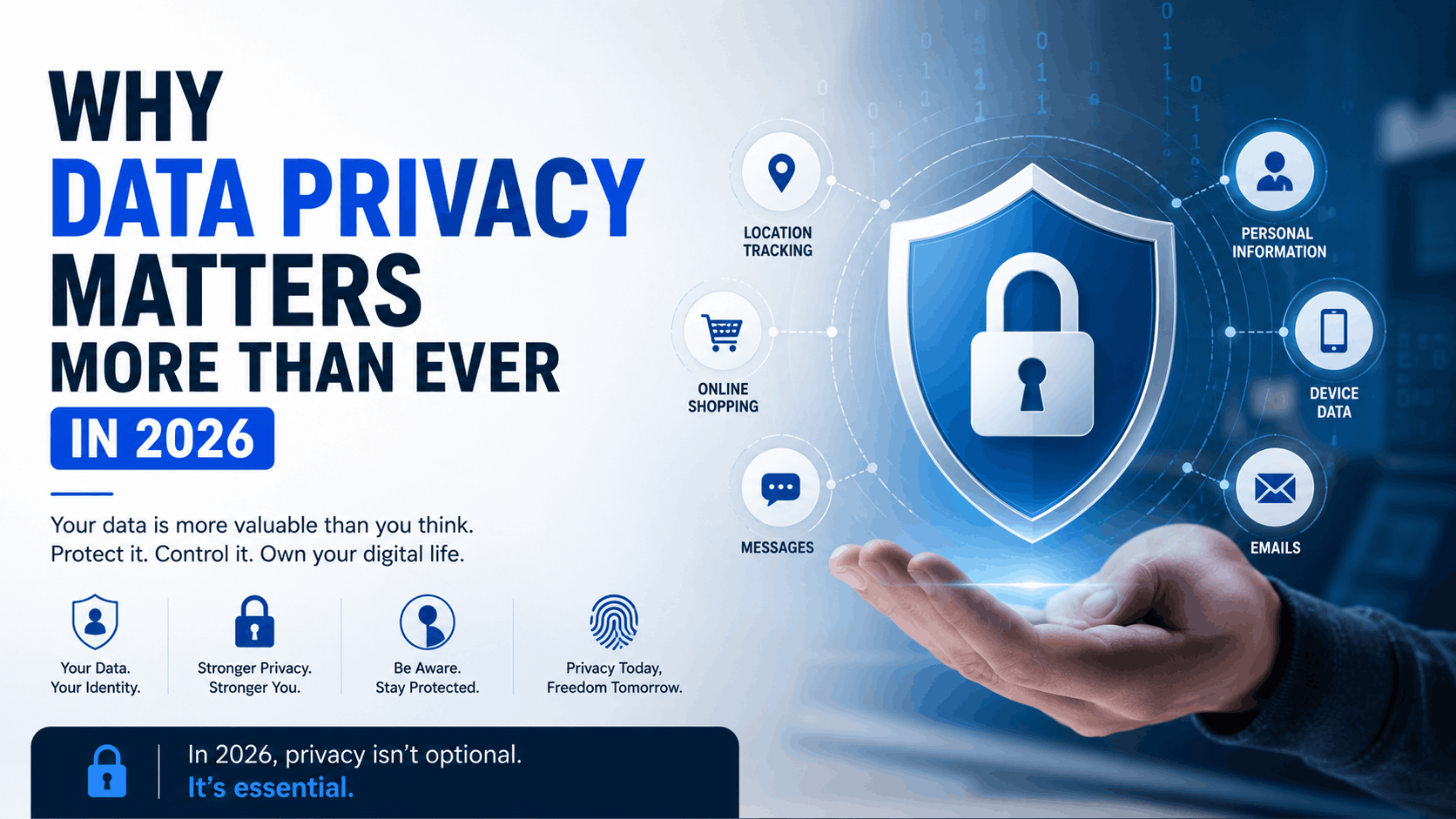
The invisible trade happening behind every click, app, device, and AI system
Introduction: Privacy Used to Feel Optional
A few years ago, most people treated data privacy like one of those settings you ignore while installing an app.
“Accept All Cookies.”
Click.
“Allow Access to Contacts?”
Sure.
“Enable Tracking?”
Whatever gets rid of the popup faster.
Privacy felt abstract.
Distant.
Technical.
But in 2026, something changed.
People started realizing:
their data isn’t just information anymore.
It’s infrastructure.
Every search, tap, location ping, voice command, purchase, photo, and interaction feeds systems that shape:
- recommendations
- advertising
- AI models
- financial decisions
- healthcare systems
- hiring processes
- online experiences
The internet no longer simply reacts to users.
It studies them.
And that’s why data privacy matters more than ever.
The Internet Runs on Data
Most modern apps are not really “free.”
They operate on an exchange.
You receive:
- social platforms
- search engines
- navigation apps
- AI assistants
- entertainment services
And in return?
You provide data.
Sometimes knowingly.
Sometimes invisibly.
What Counts as Data in 2026?
People usually think privacy means:
- passwords
- bank details
- private messages
But modern data collection goes much deeper.
Today, systems collect:
- location history
- browsing behavior
- typing patterns
- voice recordings
- shopping habits
- sleep data
- fitness metrics
- device usage
- search behavior
- facial recognition signals
Even small interactions create patterns.
And patterns are valuable.
Why Companies Want Your Data So Badly
Because data improves prediction.
And prediction drives modern business.
The more companies know:
- what you like
- what you fear
- what you click
- what keeps your attention
The better they can:
- target ads
- personalize feeds
- improve products
- influence behavior
Data is no longer just information.
It’s economic power.
The Shift Happening in 2026
The biggest change is not that companies collect data.
That’s been happening for years.
The real shift is:
AI systems now make that data dramatically more useful.
AI Changed the Scale Completely
Older systems analyzed data in limited ways.
Modern AI systems can:
- identify patterns instantly
- combine multiple data sources
- predict user behavior
- generate detailed profiles
This changes privacy entirely.
A single app may know:
- where you go
- when you sleep
- what you buy
- what topics interest you
- what mood you might be in
Not because you explicitly told it.
But because patterns reveal more than people realize.
Your Digital Life Is More Connected Than You Think
In 2026, devices don’t exist separately anymore.
Your:
- phone
- smartwatch
- browser
- smart TV
- car
- AI assistant
- shopping apps
All contribute to a connected digital profile.
That profile can become surprisingly detailed.
A Simple Example
Imagine someone:
- searches for stress symptoms
- stops sleeping well
- buys health-related products
- listens to anxiety-related content
Individually, those signals mean little.
Combined?
AI systems may infer emotional or health conditions.
That level of prediction changes everything.
The Convenience Trap
Modern technology is optimized for convenience.
And convenience is powerful.
People willingly trade privacy for:
- faster apps
- personalized experiences
- AI assistants
- recommendations
- automation
The problem is:
Convenience hides complexity.
Most users don’t fully understand:
- what data is collected
- where it goes
- how long it’s stored
- who accesses it
Smart Devices Made Privacy Harder
Smart technology exploded in recent years.
Now we have:
- smart homes
- smart speakers
- smart watches
- connected cars
- AI-powered assistants
These systems constantly collect information to function effectively.
That creates a difficult balance:
better experiences vs deeper surveillance.
The Most Valuable Resource Isn’t Oil Anymore
People often say:
“Data is the new oil.”
But that comparison is incomplete.
Oil gets consumed.
Data gets reused infinitely.
The same data can:
- train AI
- target advertising
- improve algorithms
- influence recommendations
- support analytics
Its value compounds over time.
Why Privacy Feels Different in the AI Era
Before AI became mainstream, data collection was mostly about analytics.
Now it’s about intelligence.
AI systems don’t just store data.
They interpret it.
That changes risk levels dramatically.
Deep Personalization Has a Dark Side
Personalized systems feel helpful:
- smarter recommendations
- curated feeds
- predictive suggestions
But personalization also creates:
- echo chambers
- manipulation risks
- behavioral targeting
At some point, systems stop merely understanding users.
They begin shaping behavior.
The Scary Part Isn’t Hacking
People imagine privacy threats as:
- dramatic cyberattacks
- stolen passwords
- hackers in dark rooms
But modern privacy risks are often quieter.
The real issue is:
continuous collection at massive scale.
Not one big breach.
But endless small extractions.
Facial Recognition and Identity Tracking
One of the most controversial areas in 2026 is biometric data.
Systems can now identify people using:
- facial structure
- voice patterns
- movement behavior
This introduces major ethical questions:
- Should public tracking exist?
- Who controls biometric data?
- Can users truly opt out?
Once biometric data leaks, you cannot simply “change your face” like a password.
AI Assistants and Voice Privacy
Voice assistants became smarter.
Much smarter.
But they also require:
- continuous listening systems
- speech analysis
- cloud processing
People increasingly ask:
“Where does that audio go?”
And that’s a fair question.
Healthcare Data Became Extremely Sensitive
As AI enters healthcare, medical data becomes even more valuable.
Health systems now process:
- scans
- patient histories
- wearable device metrics
- predictive health models
This improves healthcare.
But it also raises concerns about:
- ownership
- consent
- access control
Healthcare privacy in the AI era is becoming one of the biggest debates in technology.
Children Growing Up in a Tracked World
One of the most overlooked topics is digital childhood.
Today’s children grow up surrounded by:
- smart devices
- connected apps
- educational platforms
- recommendation systems
Many generate digital footprints before fully understanding privacy itself.
That creates long-term ethical concerns.
Governments and Privacy Regulation
As data collection increased, governments responded with stricter regulations.
By 2026, many regions enforce rules around:
- consent
- transparency
- data portability
- user rights
Companies now face growing pressure to explain:
- what they collect
- why they collect it
- how users can control it
Why Most People Still Ignore Privacy
Because privacy problems are invisible.
You don’t “feel” your data being collected.
There’s no alarm.
No immediate consequence.
And that’s exactly why awareness matters.
The Balance Between Privacy and Innovation
This is where things get complicated.
Data also powers:
- medical breakthroughs
- smarter systems
- accessibility tools
- fraud prevention
- AI improvements
The solution is not:
“Stop technology.”
The real challenge is:
building technology responsibly.
What Responsible Data Use Looks Like
Good systems should:
- collect only necessary data
- explain usage clearly
- allow user control
- secure information properly
- minimize unnecessary tracking
Transparency matters.
Trust matters even more.
What Individuals Can Actually Do
Most people can’t completely disconnect from modern systems.
But they can become more intentional.
Simple steps matter:
- review app permissions
- limit unnecessary tracking
- use strong passwords
- enable two-factor authentication
- understand privacy settings
- avoid oversharing publicly
Privacy is not about paranoia.
It’s about awareness.
The Future of Privacy
Over the next few years, privacy will become one of the defining technology conversations.
Not because people suddenly became fearful.
But because digital systems became deeply integrated into daily life.
The more connected technology becomes:
the more important privacy becomes.
Final Thoughts
Data privacy in 2026 is no longer a niche technical topic.
It affects:
- healthcare
- finance
- education
- social media
- AI systems
- daily life
Every click contributes to systems larger than most people realize.
And that’s why privacy matters now more than ever.
Not because technology is evil.
But because powerful systems require responsible boundaries.