The Hidden Technology Behind Swiggy and Zomato Live Tracking
Swiggy and Zomato live tracking feels simple, but behind that moving bike icon exists a massive system of GPS tracking, cloud servers, routing algorithms, and real-time prediction technology. This blog explores the hidden tech powering modern food delivery apps.

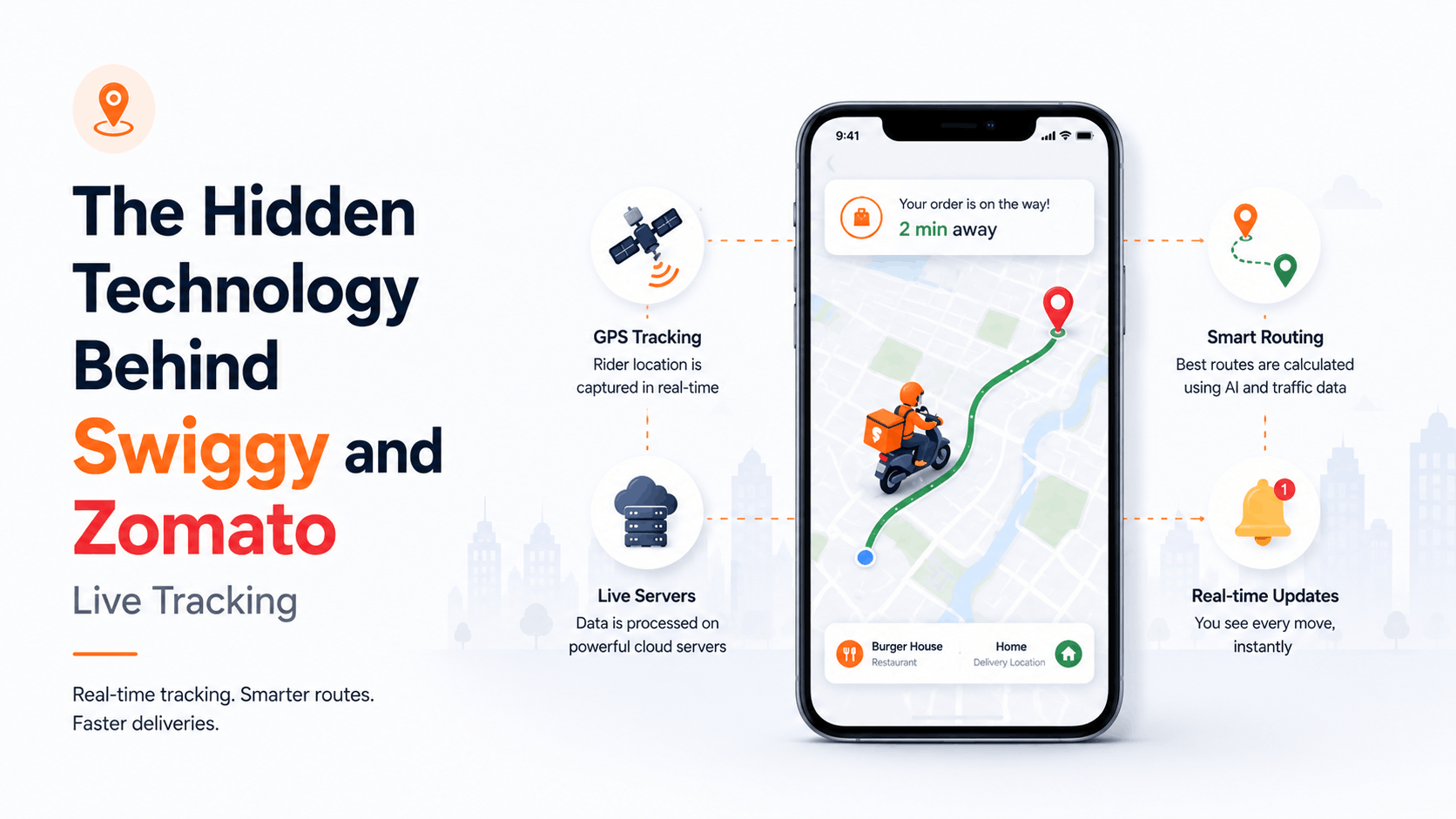
How food delivery apps track riders in real time, predict delivery times, optimize routes, and quietly run one of the most complex logistics systems in modern tech
Introduction: Watching Your Food Move Feels Weirdly Addictive
You order food.
Then suddenly…
You stop caring about the food itself for a moment.
Instead, you become obsessed with the tiny bike icon moving on the map.
You refresh constantly:
- “Why did he stop there?”
- “Why is he taking another route?”
- “He’s literally 2 minutes away.”
- “Wait… why is he going the opposite direction?”
Modern food delivery apps turned waiting into a live experience.
And honestly?
That tiny moving dot became one of the most psychologically satisfying features in modern apps.
But behind that smooth live-tracking system exists an astonishing amount of technology.
Because making a tiny bike move correctly on your screen in real time sounds simple…
Until millions of people start using it simultaneously across entire cities.
Then it becomes:
- a mapping problem
- a GPS problem
- a cloud infrastructure problem
- a prediction problem
- a logistics problem
- and sometimes…
a traffic survival problem
The hidden systems behind apps like:
- Swiggy
- Zomato
Are actually some of the most impressive large-scale real-time systems most people use every day without thinking about.
Before Live Tracking, Food Delivery Was Basically Guesswork
A few years ago, ordering food online felt completely different.
You placed order…
Then waited.
That’s it.
No live updates.
No rider location.
No prediction systems.
You simply hoped the food eventually arrived.
And honestly, that uncertainty was frustrating.
People constantly called restaurants asking:
“Where is my order?”
Live tracking solved a psychological problem as much as a logistical one.
Humans Hate Uncertainty More Than Waiting
This is important.
Research repeatedly shows:
people tolerate waiting better when they can see progress.
That’s why:
- elevators show floor numbers
- loading bars exist
- delivery apps show moving riders
Progress reduces anxiety.
And delivery apps turned this into a highly optimized user experience.
So What Actually Happens After You Order Food?
Now comes the fun part.
Let’s follow a food order from beginning to end.
Imagine this scenario:
You order:
“1 Paneer Burger + Fries”
Seems simple.
But behind the scenes, dozens of systems instantly activate.
Step 1: Your App Sends Order Data to Servers
The moment you tap:
“Place Order”
Your app creates structured digital information.
This includes:
- order items
- restaurant details
- payment confirmation
- delivery location
- customer ID
- timestamp
Then sends it to cloud servers.
This happens within milliseconds.
Modern Food Delivery Apps Are Massive Backend Systems
Most users think delivery apps are mainly:
- maps
- menus
- riders
But internally they are giant distributed systems handling:
- logistics
- payments
- GPS tracking
- traffic prediction
- routing algorithms
- restaurant coordination
- customer notifications
At a city-wide scale.
That complexity is enormous.
Step 2: Restaurant Receives the Order
Once servers process your request,
the restaurant dashboard receives order details instantly.
The restaurant system now updates:
- cooking queue
- preparation status
- estimated readiness time
At this point,
Timing becomes critical.
Because delivery apps optimize the entire process around synchronization.
The Timing Problem Is Harder Than It Looks
If rider arrives:
- too early → food isn’t ready
- too late → food becomes cold
Apps constantly balance:
- preparation timing
- rider availability
- traffic conditions
- route distance
This becomes a real-time optimization problem.
Step 3: Delivery Partner Matching Begins
Now the system must assign a rider.
This sounds easy.
But it’s surprisingly difficult.
The platform checks:
- nearby riders
- current traffic
- rider workload
- restaurant location
- delivery distance
- expected delays
Then algorithms decide:
Which rider can complete delivery most efficiently?
Algorithms Quietly Control Most Deliveries
Modern logistics systems heavily depend on algorithms.
Apps continuously calculate:
- route efficiency
- rider distribution
- predicted delivery times
- city congestion patterns
Without algorithms,
large-scale food delivery would become chaos very quickly.
Why Sometimes a Rider Farther Away Gets Assigned
Users often notice strange assignments.
Sometimes:
a nearby rider is ignored,
while another farther away gets selected.
That usually happens because systems optimize globally, not individually.
The algorithm may predict:
- better route timing
- future order clustering
- traffic efficiency
The app thinks city-wide.
Not just user-by-user.
Step 4: GPS Tracking Starts Working
Now comes the feature users actually see:
live tracking.
The rider’s phone continuously sends GPS coordinates to servers.
Usually every few seconds.
This creates real-time location updates.
Your Phone Is Basically Acting Like a Tiny GPS Transmitter
Modern smartphones constantly calculate location using:
- GPS satellites
- Wi-Fi signals
- mobile towers
- device sensors
Apps combine these signals for more accurate positioning.
This is why live tracking works surprisingly smoothly.
GPS Is Amazing… But Also Inconsistent
GPS is not perfectly accurate.
Especially in:
- crowded cities
- tunnels
- dense buildings
- weak signal areas
That’s why live tracking sometimes behaves strangely.
For example:
- rider icon jumps
- wrong turns appear
- delivery location seems delayed
The system is constantly estimating movement.
Maps Quietly Power Everything
Delivery apps rely heavily on mapping systems.
Platforms like:
- Google Maps
- location APIs
- routing infrastructure
Help calculate:
- routes
- ETA predictions
- navigation paths
- traffic-aware movement
Without mapping systems,
live delivery tracking would barely function.
ETA Prediction Is One of the Hardest Problems
Estimated delivery times seem simple.
But they’re actually incredibly difficult to predict accurately.
Because cities are unpredictable.
Apps must account for:
- traffic
- weather
- rider speed
- restaurant delays
- traffic lights
- road conditions
- order batching
All dynamically.
Why Delivery Times Constantly Change
Ever noticed:
“15 mins away."
suddenly becomes:
“22 minutes away?"
That’s because prediction systems continuously update based on live conditions.
ETA systems constantly recalculate probabilities in real time.
Machine Learning Improved Delivery Predictions Massively
Older systems relied mostly on static calculations.
Modern apps increasingly use machine learning.
AI models analyze:
- historical delivery patterns
- traffic behavior
- restaurant preparation speed
- rider movement patterns
To improve prediction accuracy.
The Rider Icon Isn’t Truly “Live”
This surprises many people.
The bike icon you see isn’t updating every millisecond.
Apps optimize updates carefully because:
constant real-time syncing would destroy:
- battery life
- network bandwidth
- server performance
So apps intelligently balance:
- smoothness
- accuracy
- infrastructure cost
Why the Movement Feels Smooth Anyway
Apps interpolate movement.
Meaning:
they estimate rider motion between actual GPS updates.
This creates the illusion of continuous movement.
Good UI design hides technical limitations beautifully.
Notification Systems Keep Everything Feeling Active
Modern delivery apps constantly update users:
- “Restaurant accepted your order”
- “Food is being prepared."
- “Rider picked up your order."
- “Rider is nearby."
These notifications are carefully designed to reduce uncertainty.
And psychologically?
They work extremely well.
The Human Brain Loves Visible Progress
One reason live tracking became addictive is because humans naturally monitor movement and progress.
Watching the rider move creates:
- anticipation
- excitement
- engagement
The waiting process itself became interactive.
Delivery Apps Quietly Became Logistics Companies
Interestingly, apps like Swiggy and Zomato are no longer “just apps.”
They operate:
- logistics networks
- rider ecosystems
- cloud systems
- routing infrastructure
- prediction engines
At an enormous scale.
They became technology-powered logistics companies.
Rush Hours Become Massive Technical Challenges
Imagine:
thousands of people ordering dinner simultaneously.
The platform must suddenly coordinate the following:
- restaurants
- riders
- payments
- routes
- tracking
- customer support
All in real time.
This creates huge infrastructure pressure.
Cloud Computing Quietly Makes It All Possible
Food delivery systems heavily depend on cloud infrastructure.
Companies use large-scale server systems to handle:
- live updates
- databases
- maps
- GPS synchronization
- analytics
- notifications
Without cloud computing,
modern delivery apps would struggle to scale.
Databases Constantly Track Everything
Behind every delivery exists enormous amounts of data:
- order status
- rider location
- customer address
- payment confirmation
- timestamps
- route history
Efficient database design becomes critical.
Especially when millions of deliveries occur daily.
Why Food Delivery Apps? Rarely Fully Crash
Because modern systems use distributed infrastructure.
Instead of one giant server,
platforms distribute workloads across multiple systems.
This improves:
- scalability
- reliability
- fault tolerance
Large-scale apps are designed expecting failures to happen.
Fraud Detection Quietly Runs in Background
Delivery apps also monitor:
- fake orders
- suspicious payments
- account abuse
- delivery fraud
Machine learning increasingly helps identify unusual patterns automatically.
Most users never notice this invisible security layer.
Rider Apps Are Extremely Important Too
Customers only see one side of system.
But rider apps themselves are highly sophisticated.
They manage:
- navigation
- earnings
- route updates
- pickup timing
- customer communication
The rider ecosystem depends heavily on mobile infrastructure.
Battery Optimization Is a Huge Hidden Problem
Constant GPS usage drains battery aggressively.
Delivery apps optimize carefully to reduce:
- battery consumption
- overheating
- excessive data usage
This is why location tracking systems are engineered very carefully.
Weather Makes Everything Harder
Rain dramatically complicates delivery systems.
Because suddenly:
- traffic slows
- riders move differently
- delivery time predictions fail
- order demand spikes
Real-world unpredictability constantly challenges algorithms.
AI Will Change Food Delivery Even More
Future delivery systems may use AI for:
- smarter route prediction
- demand forecasting
- automated logistics optimization
- delivery clustering
- traffic adaptation
The systems are becoming increasingly intelligent.
The Future Might Not Even Involve Human Riders
This is where things become futuristic.
Some companies already experiment with the following:
- delivery robots
- drones
- autonomous systems
Although large-scale adoption still faces huge challenges.
The Most Interesting Part
Modern food delivery apps transformed something ordinary:
“bringing food”
Into one of the most sophisticated real-time logistics experiences in consumer technology.
And most people only notice the following:
The tiny moving bike icon.
That’s honestly kind of amazing.
Final Thoughts
Live food tracking feels simple because modern apps hide enormous technical complexity behind smooth interfaces.
Behind every delivery exists the following:
- GPS systems
- mapping APIs
- cloud infrastructure
- machine learning
- databases
- routing algorithms
- real-time synchronization
Working together constantly.
The next time you watch your delivery rider moving on the map,
Remember:
You’re not just tracking food.
You’re watching a massive real-time logistics network operating live across an entire city.