The Future of E-commerce Technology
The future of e-commerce is being shaped by AI, automation, personalization, and smarter digital systems. This blog explores how modern technology is transforming online shopping, customer experiences, payments, logistics, and the future of digital commerce.

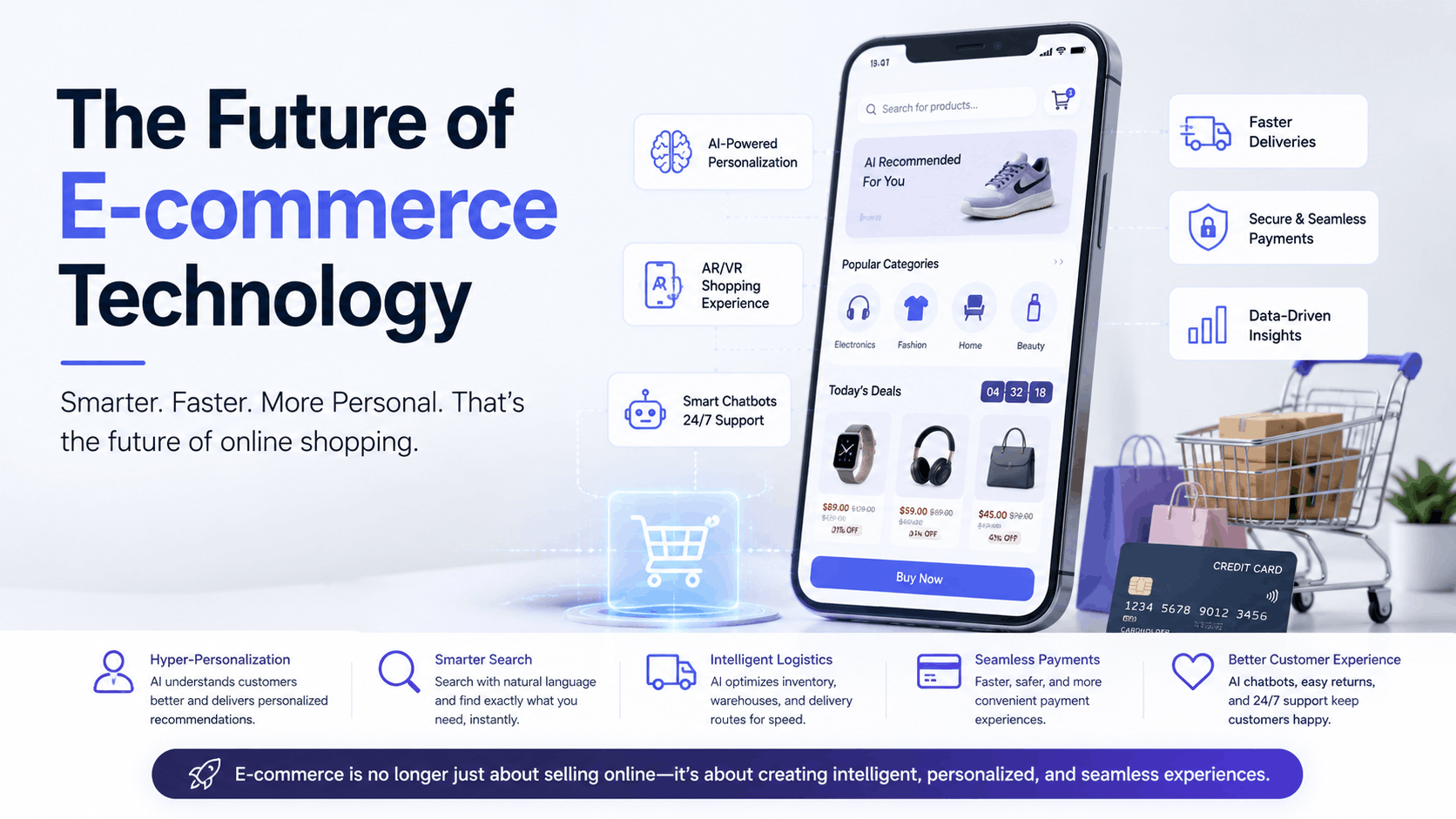
How AI, automation, personalization, and digital infrastructure are reshaping online shopping
Introduction: Online Shopping Is Changing Faster Than Most People Realize
A few years ago, e-commerce was mostly about convenience.
You opened an app.
Searched for a product.
Clicked “Buy Now.”
Waited for delivery.
Simple.
But in 2026, e-commerce is becoming something much bigger.
Shopping platforms are evolving into the following:
- intelligent systems
- personalized experiences
- AI-driven ecosystems
- automated infrastructures
Modern e-commerce is no longer just about selling products online.
It’s becoming a technology industry of its own.
And the next few years will completely redefine the following:
- how people discover products
- how businesses operate
- how deliveries happen
- how customer experiences are designed
The future of e-commerce is not simply “digital shopping.”
It’s intelligent commerce.
Why E-commerce Technology Is Evolving So Quickly
The growth of online shopping changed customer expectations permanently.
People now expect:
- instant experiences
- personalized recommendations
- faster delivery
- smooth payments
- intelligent support
- mobile-first design
At the same time, businesses face increasing pressure:
- more competition
- rising ad costs
- customer retention problems
- operational complexity
Technology became the only way to scale efficiently.
AI Is Becoming the Brain of Modern E-commerce
Artificial intelligence is now powering almost every major e-commerce platform.
Not visibly.
But underneath nearly everything users interact with.
Personalized Recommendations
Recommendation systems have become dramatically smarter.
Modern AI analyzes:
- browsing behavior
- purchase history
- time spent viewing products
- click patterns
- wishlist activity
To predict:
“What is this customer most likely to buy next?”
This is why platforms increasingly feel like they “understand” users.
The Interesting Shift
Old recommendation systems were rule-based.
Modern AI systems are predictive.
They continuously learn from behavior in real time.
That changes:
- conversion rates
- customer retention
- user engagement
Massively.
Search Is Becoming Conversational
Traditional e-commerce search:
- required exact keywords
- depended heavily on filters
But modern AI-powered search is changing this.
Users can now search naturally:
- “comfortable shoes for long walks”
- “minimalist desk setup accessories”
- “gaming laptop for students under budget”
AI understands intent, not just keywords.
This makes product discovery dramatically easier.
The Rise of AI Shopping Assistants
One of the fastest-growing trends is AI-powered shopping assistance.
Modern assistants can:
- compare products
- answer questions
- explain specifications
- recommend alternatives
- guide purchases
Instead of scrolling endlessly through product pages, users increasingly interact conversationally.
Shopping is becoming interactive.
Hyper-Personalization Is the New Standard
In the future of e-commerce, generic experiences disappear.
Different users increasingly see:
- different homepages
- different recommendations
- different promotions
- different product rankings
AI systems personalize entire shopping journeys.
Why This Matters
Attention is limited.
Platforms that understand customers better:
- retain users longer
- increase purchases
- improve satisfaction
Personalization becomes competitive advantage.
AR and Virtual Shopping Experiences
Augmented Reality is transforming online shopping experiences.
Customers can now:
- preview furniture in their homes
- try glasses virtually
- test makeup digitally
- visualize products before buying
This reduces uncertainty.
And uncertainty is one of the biggest reasons people avoid purchasing online.
Faster Delivery Is Becoming a Technology Problem
Delivery speed is no longer just logistics.
It’s a software challenge.
Modern e-commerce systems use AI for the following:
- route optimization
- warehouse automation
- inventory prediction
- delivery forecasting
The future of delivery depends heavily on intelligent systems.
Smart Warehouses Are Quietly Transforming Retail
Many large e-commerce operations now use:
- robotic sorting systems
- AI inventory management
- automated packaging systems
Warehouses increasingly function like software-driven ecosystems.
This improves:
- efficiency
- speed
- scalability
Voice Commerce Is Slowly Growing
Voice assistants are becoming part of shopping behavior.
Users increasingly:
- reorder products by voice
- search using voice commands
- interact with smart assistants
While still growing, voice commerce represents another major shift in user interaction.
Mobile Commerce Continues Dominating
Mobile devices are now the center of e-commerce.
Shopping experiences are increasingly designed:
- mobile-first
- app-first
- touch-first
Businesses that ignore mobile optimization fall behind quickly.
Social Commerce Is Reshaping Discovery
People increasingly discover products through:
- short videos
- creators
- live streams
- social recommendations
Social platforms are evolving into shopping ecosystems.
The line between:
- entertainment
- advertising
- shopping
Is disappearing.
Payments Are Becoming Invisible
The future of payments is frictionless.
Users expect:
- one-click checkout
- digital wallets
- instant payment systems
- biometric authentication
The easier payments become:
the higher conversion rates grow.
Subscription Commerce Is Expanding
More businesses are shifting toward recurring models.
Examples:
- subscription boxes
- auto-refill systems
- memberships
- digital subscriptions
Predictable recurring revenue is becoming increasingly valuable for businesses.
Sustainability Is Becoming a Competitive Factor
Consumers increasingly care about:
- eco-friendly packaging
- ethical sourcing
- sustainable logistics
Technology now helps companies:
- optimize delivery routes
- reduce waste
- improve supply chain visibility
Sustainability is no longer just branding.
It’s becoming operational strategy.
Data Is the Core of modern e-commerce.
Every interaction creates signals.
Platforms track:
- clicks
- searches
- abandoned carts
- scroll behavior
- purchasing trends
Data powers:
- recommendations
- advertising
- inventory decisions
- pricing strategies
Modern e-commerce runs on analytics.
Dynamic Pricing Is Becoming Smarter
Some systems now adjust pricing based on:
- demand
- competition
- timing
- inventory levels
AI allows businesses to respond faster to market behavior.
Fraud Detection Is More Important Than Ever
As e-commerce grows, fraud grows too.
Modern AI systems now monitor:
- suspicious transactions
- unusual purchasing behavior
- account activity patterns
Security systems increasingly rely on machine learning.
Customer Support Is Being Reinvented
Support systems are evolving rapidly.
AI chat systems now handle:
- order tracking
- refunds
- FAQs
- product assistance
This reduces wait times dramatically.
But the best systems still escalate complex problems to humans.
The Biggest Challenge: Trust
As technology becomes more advanced, trust becomes more important.
Customers increasingly ask:
- Is my data secure?
- Is this recommendation genuine?
- Can I trust this seller?
Future e-commerce success depends heavily on credibility and transparency.
Small Businesses Are Gaining Powerful Tools
One interesting shift is accessibility.
Small businesses now have access to:
- AI tools
- automation systems
- global marketplaces
- advanced analytics
Technology is lowering barriers dramatically.
The Future Store May Not Look Like a Store
Future shopping experiences may become:
- conversational
- predictive
- immersive
- automated
Instead of manually searching for products, systems may increasingly:
- anticipate needs
- recommend purchases
- automate replenishment
Commerce becomes proactive instead of reactive.
The Human Side Still Matters
Despite all the automation, people still value:
- trust
- emotional connection
- storytelling
- brand identity
Technology improves systems.
But humans still shape experiences.
The Future of E-commerce Is Not Just Online Shopping
It’s:
- AI
- logistics
- personalization
- infrastructure
- automation
- behavioral understanding
E-commerce is evolving into an intelligent ecosystem powered by data and software.
Final Thoughts
The future of e-commerce technology is not about one breakthrough.
It’s about many systems quietly evolving together.
AI improves recommendations.
Automation improves logistics.
Personalization improves engagement.
Data improves decisions.
Together, they completely reshape online commerce.
The next generation of e-commerce platforms will not simply sell products better.
They will understand customers better.
And that changes everything.