The Evolution of Mobile App Development
Mobile app development has evolved from simple phone utilities into intelligent, AI-powered digital ecosystems. This blog explores how smartphones, app stores, cross-platform frameworks, cloud systems, and modern technologies transformed the mobile experience.

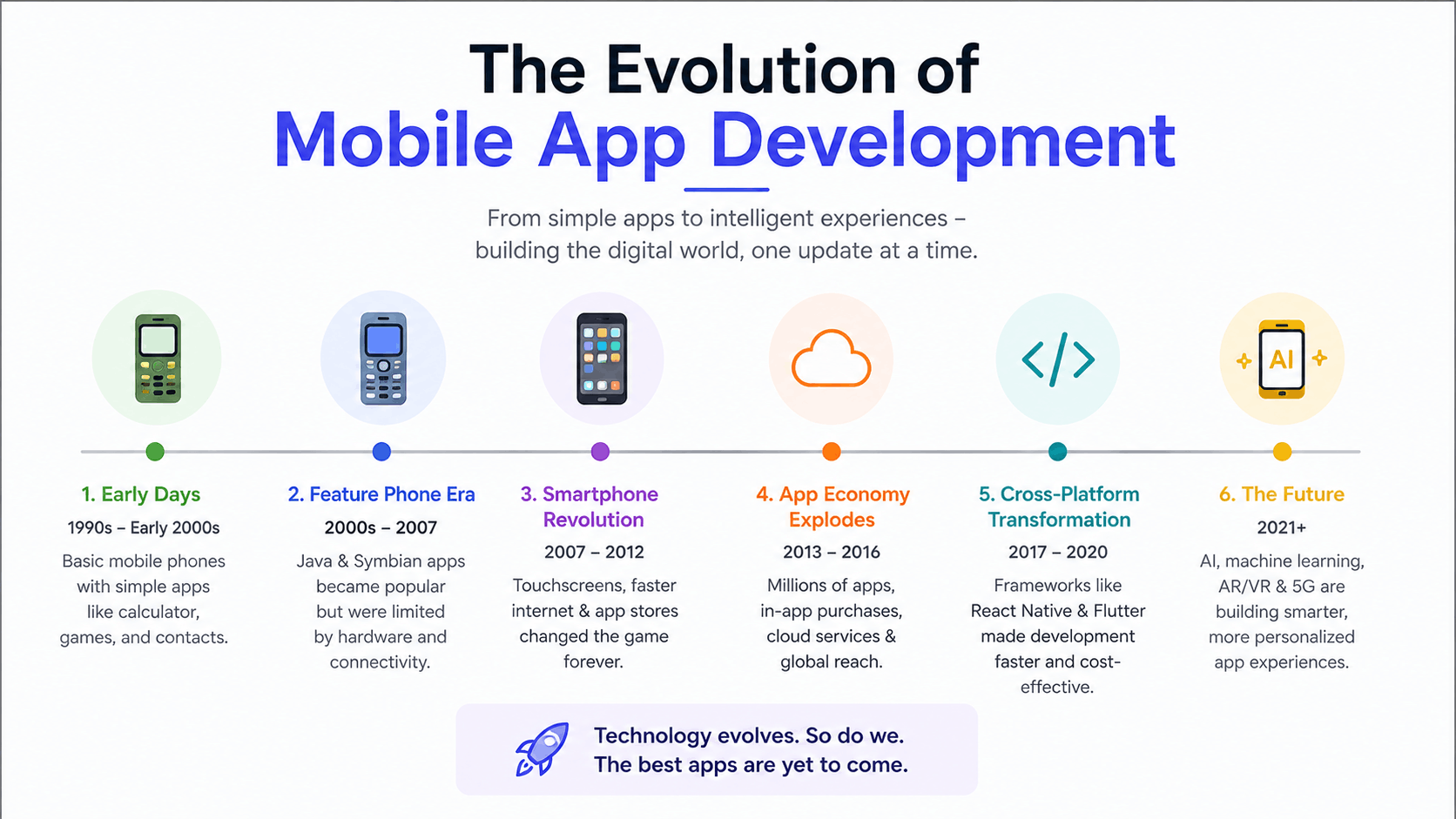
How mobile apps evolved from simple utilities into intelligent digital ecosystems
Introduction: Mobile Apps Quietly Took Over the World
It’s difficult to imagine modern life without mobile apps.
Today, people use apps for the following:
- communication
- banking
- shopping
- navigation
- entertainment
- healthcare
- education
- work
Apps are no longer just software.
They’ve become infrastructure for everyday life.
But mobile apps didn’t start this way.
The first generation of mobile applications was incredibly limited compared to what exists today.
Tiny screens.
Slow internet.
Basic interfaces.
Minimal functionality.
And yet, those early systems started a technological shift that would completely transform how humans interact with the digital world.
The evolution of mobile app development is not just a story about coding.
It’s a story about:
- changing technology
- changing user behavior
- faster internet
- smarter devices
- evolving design philosophies
- and increasingly intelligent systems
In many ways, the smartphone became the most important computing platform humans have ever created.
Before Smartphones: The Beginning of Mobile Software
Before app stores existed, mobile software was extremely simple.
Early phones included:
- calculators
- alarms
- calendars
- contact books
- simple games
That was enough to feel revolutionary at the time.
Devices were limited by:
- weak processors
- tiny memory
- low-resolution displays
- physical keypads
Developers had to build software under severe technical constraints.
The Era of Java and Symbian Apps
Before modern app ecosystems, many phones used:
- Java ME
- Symbian OS
- BlackBerry systems
Applications were often:
- difficult to install
- inconsistent across devices
- limited in capability
User experience was fragmented.
Developers faced major problems:
- different screen sizes
- inconsistent hardware
- platform limitations
Building mobile apps was much harder than people realize today.
Then the Smartphone Changed Everything
The real transformation started when smartphones evolved into touch-first devices.
This shifted mobile development completely.
Suddenly:
- screens became larger
- internet became usable
- interfaces became interactive
- applications became immersive
The phone stopped being just a communication device.
It became a portable computer.
The App Store Revolution
One of the biggest turning points in mobile history was the rise of app stores.
This changed everything for both:
- users
- developers
Before app stores:
- The distribution was difficult
- discovery was limited
- Updates were inconsistent
App stores created centralized ecosystems.
Now developers could:
- publish globally
- update apps instantly
- monetize software directly
This democratized software development at a massive scale.
Mobile Apps Became Businesses
As smartphones spread globally, apps became entire industries.
Companies emerged around:
- social media apps
- messaging platforms
- gaming ecosystems
- ride-sharing services
- delivery systems
- streaming platforms
Mobile apps stopped supporting businesses.
They became businesses.
The Rise of Native Mobile Development
As app complexity increased, developers needed better tools.
Native development became dominant.
This meant building apps specifically for:
- iOS
- Android
Using platform-specific technologies.
For years:
- Swift / Objective-C dominated iOS
- Java / Kotlin dominated Android
Native apps offered:
- better performance
- smoother UI
- deeper hardware integration
But there was a problem.
The Cost of Building Two Separate Apps
Businesses quickly realized:
Maintaining two codebases is expensive.
You needed:
- two development teams
- duplicated logic
- separate testing
- parallel updates
This created demand for better solutions.
Cross-Platform Development Changed the Industry
Frameworks like:
- React Native
- Flutter
- Xamarin
Started transforming app development.
Instead of building everything twice, developers could share significant code across platforms.
This dramatically reduced:
- development time
- maintenance cost
- team complexity
Cross-platform development became one of the biggest shifts in modern app engineering.
Why React Native Became So Popular
React Native succeeded because it combined:
- web development familiarity
- native mobile capability
Developers who already knew React could transition into mobile development much faster.
This lowered barriers dramatically.
Small teams could suddenly launch mobile apps faster than ever before.
Flutter Changed UI Expectations
Flutter introduced another major evolution:
consistent, highly customizable interfaces.
Its rendering system allowed developers to create:
- smooth animations
- modern UI experiences
- visually polished apps
Flutter helped push mobile design quality much higher.
Mobile Design Evolved Alongside Development
Early mobile apps focused mainly on functionality.
Modern apps focus heavily on:
- user experience
- simplicity
- responsiveness
- accessibility
- emotional design
Users now expect apps to:
- feel smooth
- load instantly
- behave predictably
- look polished
Bad design is no longer tolerated easily.
Internet Speed Changed Everything
Mobile app evolution also depended heavily on internet infrastructure.
As networks improved:
- 3G
- 4G
- 5G
Apps became:
- more connected
- more real-time
- more cloud-dependent
Modern apps constantly communicate with servers.
This enabled:
- streaming
- live messaging
- cloud sync
- multiplayer gaming
- instant updates
APIs Became the Backbone of Mobile Apps
Most modern apps are no longer isolated software.
They depend on APIs for:
- authentication
- payments
- notifications
- databases
- analytics
- cloud storage
Mobile development increasingly became:
frontend + backend ecosystems working together.
Cloud Computing Reshaped Mobile Architecture
Cloud services dramatically simplified development.
Instead of managing everything manually, developers now use:
- Firebase
- AWS
- Supabase
- cloud databases
- authentication systems
This accelerated app development significantly.
Small teams gained access to enterprise-level infrastructure.
Mobile Apps Became Data-Driven Systems
Modern apps continuously analyze:
- user behavior
- session duration
- clicks
- retention
- engagement patterns
Analytics became central to app development.
Apps now evolve based on real usage data.
Notifications Changed User Behavior
Push notifications became one of the most influential mobile features ever introduced.
Apps now actively compete for attention.
Notifications transformed engagement:
- reminders
- marketing
- updates
- retention strategies
This changed how people interact with technology daily.
The Dark Side of Mobile Evolution
Not every change improved digital life.
Modern apps increasingly compete for:
- attention
- screen time
- behavioral engagement
This introduced concerns around:
- addiction
- distraction
- excessive notifications
- algorithmic influence
Mobile technology became psychologically powerful.
Security Became More Important Than Ever
As apps began handling:
- banking
- healthcare
- personal messaging
- payments
Security became critical.
Modern mobile development now includes:
- biometric authentication
- encryption
- secure APIs
- privacy controls
Users expect apps to protect sensitive information.
AI Is Becoming the Next Major Shift
The newest transformation in mobile development is AI integration.
Modern apps increasingly include:
- AI assistants
- recommendation systems
- voice interfaces
- predictive features
- intelligent automation
Apps are becoming smarter and more adaptive.
Mobile Apps Are Becoming More Personalized
Future apps increasingly adapt to individual users.
Systems now personalize:
- content
- recommendations
- interfaces
- experiences
AI-driven personalization is shaping the future of mobile UX.
Super Apps Are Changing User Expectations
Some platforms now combine:
- messaging
- payments
- shopping
- services
- entertainment
Into unified ecosystems.
Users increasingly expect apps to do more in one place.
Low-Code and No-Code Development Is Expanding
One of the most interesting modern trends is accessibility.
People can now build applications using:
- visual tools
- drag-and-drop systems
- low-code platforms
This lowers entry barriers significantly.
AR and Immersive Mobile Experiences
Mobile apps are increasingly integrating:
- augmented reality
- real-time 3D experiences
- immersive interfaces
Especially in:
- gaming
- shopping
- education
- navigation
The line between digital and physical experiences continues blurring.
The Future of Mobile Development
Over the next few years, mobile apps will likely become:
- more intelligent
- more predictive
- more personalized
- more connected
Apps may increasingly anticipate needs before users explicitly request them.
That changes the relationship between humans and software entirely.
But One Thing Still Matters Most
Despite all technological changes, the core principle remains the same:
Good apps solve real problems.
Technology evolves constantly.
But users still value:
- simplicity
- reliability
- speed
- trust
- intuitive experiences
The best apps are not always the most complex.
They’re the ones people genuinely enjoy using.
Final Thoughts
The evolution of mobile app development reflects something larger than software.
It reflects how human behavior evolves alongside technology.
Apps transformed from simple tools into intelligent ecosystems influencing:
- communication
- commerce
- entertainment
- productivity
- culture itself
And the evolution is far from finished.
The next generation of mobile apps will likely feel dramatically different from today’s systems.
Not just because devices become smarter.
But because software itself is becoming more adaptive, connected, and intelligent.