How AI Is Transforming Healthcare in 2026
AI is transforming healthcare in 2026 through smarter diagnostics, personalized treatments, predictive care, and automated systems. This blog explores how artificial intelligence is reshaping modern medicine and changing the future of patient care.

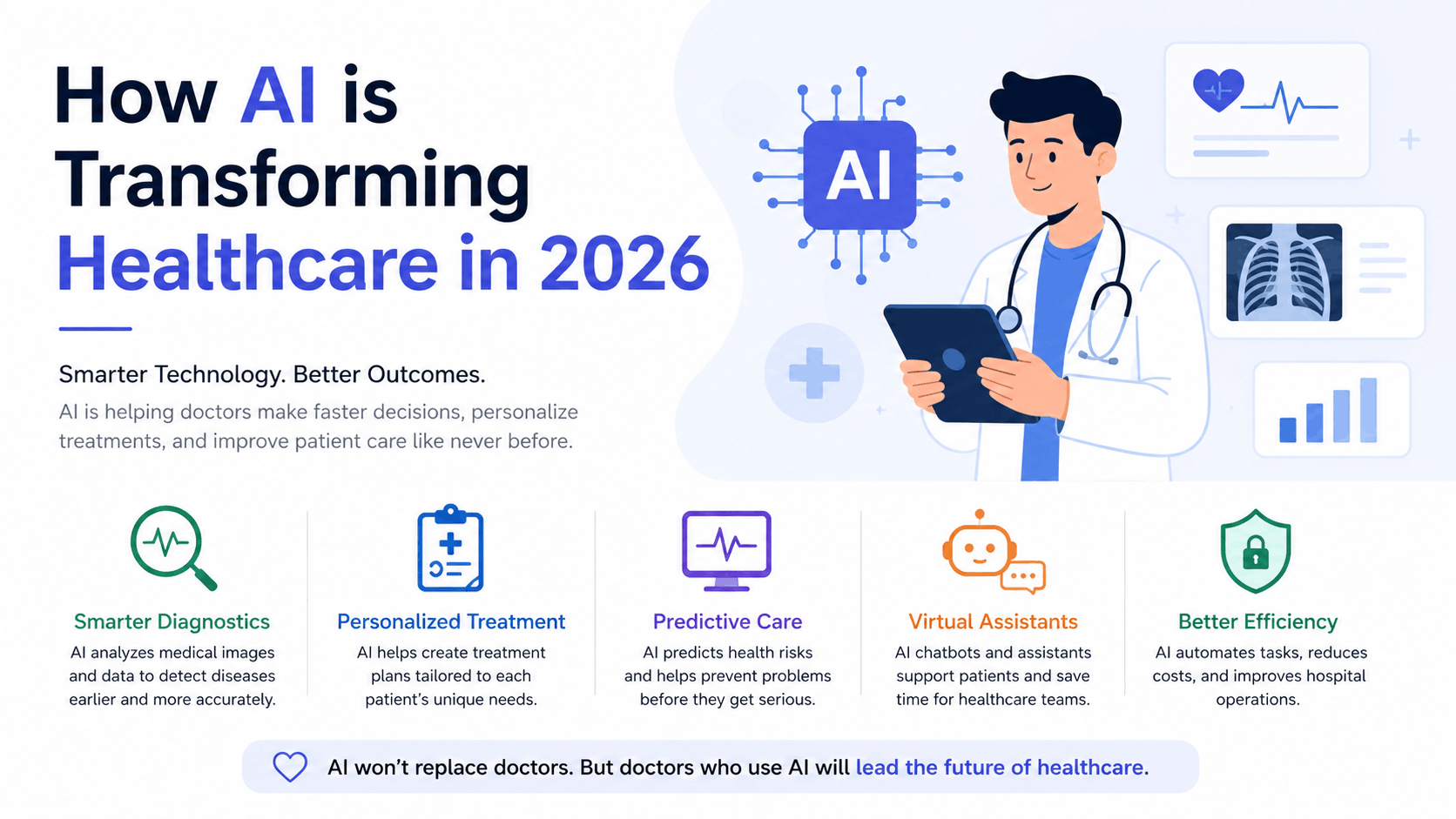
A deep dive into the hospitals, tools, systems, and decisions quietly changing modern medicine
Introduction: Healthcare Is Entering a Different Era
A few years ago, most people thought AI in healthcare meant:
- Robot doctors
- Futuristic surgeries
- Sci-fi hospitals with glowing screens everywhere
Reality turned out to be much more interesting.
AI didn’t arrive like a dramatic movie scene.
It arrived quietly.
Inside:
- Hospital software
- Diagnostic systems
- Medical imaging
- Patient monitoring tools
- Research labs
- Scheduling systems
- Administrative workflows
And now in 2026, healthcare is reaching a point where AI is no longer “experimental.”
It’s operational.
Doctors are using it daily.
Hospitals are investing heavily into it.
Patients are interacting with it without even realizing.
But here’s what makes this topic fascinating:
AI is not replacing healthcare professionals.
It’s reshaping how they work.
And that difference matters.
Why Healthcare Needed AI in the First Place
Healthcare systems have struggled with the same problems for years:
- Too much paperwork
- Too few doctors
- Slow diagnostics
- Burnout
- Administrative overload
- Rising patient demand
Modern healthcare generates enormous amounts of data:
- Lab reports
- Medical images
- Patient histories
- Prescriptions
- Monitoring data
Humans alone cannot process this efficiently at scale anymore.
That’s where AI became valuable.
Not because doctors aren’t skilled.
But because the system itself became too complex.
What “AI in Healthcare” Actually Means
Before going further, let’s simplify something important.
AI in healthcare does not mean the following:
“A robot independently treating patients.”
In reality, AI usually acts as the following:
- Assistant
- Analyzer
- Predictor
- Automation layer
- Decision-support system
Think of it as a very fast pattern-recognition engine.
It helps humans:
- See trends faster
- Reduce repetitive work
- Improve decision-making
The Biggest Areas AI Is Transforming in 2026
Let’s explore where the real impact is happening.
1. AI-Powered Diagnostics
This is one of the biggest breakthroughs.
AI systems can now analyze:
- X-rays
- MRIs
- CT scans
- Skin images
- Eye scans
And detect patterns that might be difficult to spot quickly.
The Interesting Part
AI doesn’t “see” images like humans.
Instead:
- It analyzes millions of data points
- Compares patterns
- Predicts probabilities
Example:
An AI system reviewing lung scans can identify suspicious abnormalities faster than traditional workflows.
That doesn’t mean:
“AI replaces radiologists.”
It means:
Radiologists now work with an intelligent assistant.
Why This Matters
Healthcare speed matters.
A delayed diagnosis can change outcomes dramatically.
AI helps:
- Prioritize urgent cases
- Reduce workload
- Improve detection accuracy
2. Administrative Automation (The Less Glamorous Revolution)
This part gets less attention, but it may be the biggest transformation of all.
Doctors spend massive amounts of time on:
- Documentation
- Scheduling
- Insurance workflows
- Record updates
Not treatment.
Paperwork.
And AI is aggressively reducing this burden.
AI Medical Scribes
In 2026, many healthcare systems use AI-powered transcription tools that:
- Listen to doctor-patient conversations
- Generate summaries automatically
- Update medical records
Instead of typing for hours, doctors focus more on patients.
That changes healthcare quality directly.
3. Personalized Treatment Plans
Traditional medicine often follows generalized treatment paths.
AI is pushing healthcare toward personalization.
Systems now analyze:
- Medical history
- Genetics
- Lifestyle patterns
- Previous treatment outcomes
To help recommend:
- Better medications
- More targeted treatments
- Risk predictions
Why This Is Huge
Two patients may have:
- The same disease
- Different biology
AI helps identify those differences faster.
4. Drug Discovery Is Accelerating
Drug development traditionally takes:
- Years
- Massive budgets
- Endless testing cycles
AI is helping researchers:
- Simulate compounds faster
- Predict molecule behavior
- Analyze research data rapidly
This dramatically speeds up early-stage research.
The Interesting Shift
AI is not “inventing medicine alone.”
It’s reducing the amount of repetitive trial-and-error humans must perform.
That changes timelines significantly.
5. Predictive Healthcare
This is where healthcare becomes proactive instead of reactive.
AI systems can monitor patterns and predict:
- Disease risks
- Patient deterioration
- Hospital readmissions
Before major symptoms appear.
Example
Wearable devices now collect:
- Heart rate
- Sleep patterns
- Oxygen levels
- Activity data
AI analyzes these signals and can detect unusual trends early.
Healthcare moves from
“Treat after problem."
Toward:
“Identify risk before problem."
6. Virtual Healthcare Assistants
In 2026, AI chat systems are becoming part of patient interaction.
These systems help:
- Schedule appointments
- Answer basic health questions
- Guide patients through processes
- Provide medication reminders
This reduces pressure on support teams.
But There’s a Catch
Healthcare information is sensitive.
AI assistants must:
- Protect privacy
- Avoid misinformation
- Escalate serious issues to professionals
This is why healthcare AI requires much stricter oversight than regular AI apps.
7. AI in Mental Health Support
This area is growing rapidly.
AI-powered systems now help with:
- Mood tracking
- Behavioral analysis
- Guided mental wellness exercises
Some platforms can detect patterns linked to:
- Anxiety
- Stress
- Emotional shifts
Important Reality Check
AI is not replacing therapists.
But it can
- Improve accessibility
- Support early intervention
- Reduce barriers for people seeking help
8. Remote Patient Monitoring
Hospitals are increasingly monitoring patients remotely using AI systems.
This became much more important after global healthcare systems realized:
Not every patient needs to stay physically inside hospitals.
AI helps monitor:
- Recovery progress
- Chronic conditions
- Risk indicators
This reduces:
- Hospital crowding
- Costs
- Unnecessary visits
The Hidden Problem Nobody Talks About
Now let’s discuss the uncomfortable part.
AI in healthcare is powerful.
But it’s not perfect.
And healthcare cannot afford careless mistakes.
The Risks of AI in Healthcare
1. AI Hallucinations
AI can generate:
- Incorrect recommendations
- False summaries
- Confidently wrong outputs
In normal apps, this is annoying.
In healthcare, it’s dangerous.
2. Bias in Training Data
If AI systems are trained on limited datasets:
- Some populations may be underrepresented
- Predictions become less accurate for certain groups
This is a serious ethical issue.
3. Privacy Concerns
Healthcare data is extremely sensitive.
Questions become:
- Who owns patient data?
- How is it stored?
- Who can access it?
AI systems must comply with strict privacy regulations.
The Human Factor Still Matters Most
One of the biggest misconceptions is the following:
“AI will replace doctors.”
That’s unlikely.
Because healthcare is not just information processing.
It involves:
- Judgment
- Context
- Ethics
- Emotional understanding
- Trust
AI helps with data.
Humans handle care.
The Most Interesting Shift Happening Right Now
Healthcare professionals are slowly becoming the following:
“AI-assisted experts.”
This changes workflows dramatically.
Doctors increasingly use AI like the following:
- Developers use IDEs
- Designers use creative tools
- Analysts use dashboards
Not replacement.
Enhancement.
What Hospitals Are Learning in 2026
Hospitals are discovering something important:
The biggest value of AI is not replacing humans.
It’s reducing friction.
Examples:
- Faster diagnostics
- Less admin work
- Better patient prioritization
- More efficient systems
Healthcare systems become smoother.
That alone is transformative.
Will AI Make Healthcare Cheaper?
Potentially.
But not immediately.
Why?
Because:
- Infrastructure costs are high
- Regulations are strict
- Integration is difficult
However, long-term:
- Better efficiency
- Early detection
- Reduced administrative costs
Could significantly reduce healthcare strain.
The Future of AI in Healthcare
The next few years will likely bring:
- More personalized medicine
- Better predictive systems
- Smarter hospital operations
- Improved patient monitoring
- Faster medical research
But success depends on balance.
Too little AI:
- Systems remain overloaded
Too much blind trust in AI:
- Risks increase
Healthcare needs both:
- Human expertise
- Intelligent systems
Final Thoughts
AI is not magically fixing healthcare overnight.
But it is reshaping it in meaningful ways.
Quietly.
System by system.
Workflow by workflow.
The most important thing happening in 2026 is not that AI became smarter.
It’s that healthcare systems finally started learning how to use it properly.
And that distinction changes everything.