GraphQL Explained: The Modern Way APIs Are Changing
GraphQL is changing how modern APIs work by giving clients the power to request exactly the data they need. This blog explores how GraphQL compares to REST, why developers love it, and when it actually makes sense to use.

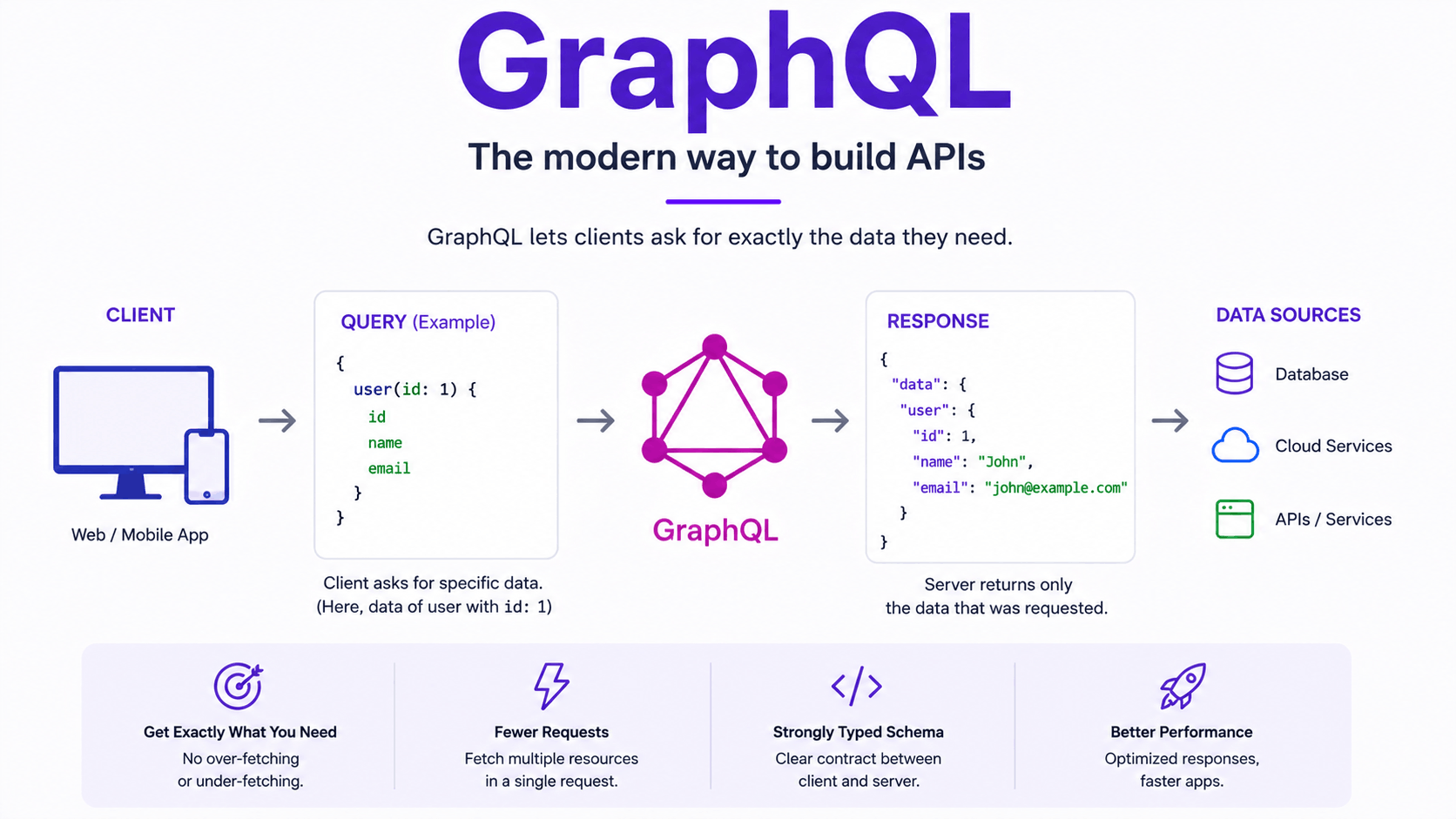
Why developers are moving beyond traditional REST APIs and how GraphQL is reshaping frontend-backend communication
Introduction: APIs Started Becoming a Problem
For years, REST APIs dominated web development.
And honestly?
They worked well.
You could:
- fetch users
- create products
- update orders
- connect frontend and backend
Simple.
But as applications became larger and more interactive, developers started running into frustrating problems.
Frontend teams wanted:
- faster responses
- less unnecessary data
- flexible queries
- smoother developer experience
Instead, they often got:
- over-fetching
- under-fetching
- too many API calls
- messy endpoint structures
At some point, modern apps became too dynamic for rigid API systems.
That’s where GraphQL entered the conversation.
And it didn’t just introduce a new API style.
It changed how developers think about data itself.
What Is GraphQL?
GraphQL is a query language for APIs.
Instead of the server deciding:
“Here’s all the data you get."
The client can say:
“Here’s exactly the data I need."
That difference sounds small.
But it changes everything.
The Traditional REST API Approach
Let’s say you want:
- user name
- profile image
Using REST:
GET /users/1
The server may return:
{
  "id": 1,
  "name": "John",
  "email": "john@example.com",
  "profileImage": "image.png",
  "createdAt": "...",
  "updatedAt": "...",
  "address": "...",
  "settings": {...}
}
You only needed three fields.
But you received everything.
This is called:
over-fetching.
The Opposite Problem: Under-Fetching
Sometimes one endpoint isn’t enough.
You fetch:
- user data
- then posts
- then comments
- then notifications
Now frontend makes multiple requests.
This becomes:
- slower
- harder to manage
- inefficient on mobile networks
That’s under-fetching.
GraphQL Solves This Differently
With GraphQL, frontend requests only what it needs.
Example:
query {
  user(id: 1) {
    name
    email
    profileImage
  }
}
Response:
{
  "data": {
    "user": {
      "name": "John",
      "email": "john@example.com",
      "profileImage": "image.png"
    }
  }
}
Nothing extra.
Nothing missing.
Why This Felt Revolutionary
GraphQL gave frontend developers more control.
Instead of the backend deciding everything:
The frontend could shape responses dynamically.
This became incredibly valuable for the following:
- mobile apps
- dashboards
- dynamic interfaces
- complex frontend systems
The Facebook Connection
GraphQL was originally developed by Meta (formerly Facebook).
Why?
Because Facebook faced enormous frontend complexity.
Different devices needed:
- different data
- different performance optimization
- flexible querying
REST became difficult to scale efficiently for those needs.
GraphQL emerged as a solution.
Understanding the Core Idea
GraphQL revolves around a few core concepts:
- Queries
- Mutations
- Schemas
- Resolvers
At first, these terms sound intimidating.
But they’re simpler than they appear.
Queries: Asking for Data
Queries are used to fetch data.
Example:
query {
  posts {
    title
    author
  }
}
You define exactly what you want.
That’s the core philosophy of GraphQL.
Mutations: Changing Data
Mutations handle:
- creating
- updating
- deleting
Example:
mutation {
  createPost(title: "GraphQL Guide") {
    id
    title
  }
}
Similar idea.
You request exactly what response you want back.
Schemas: The Blueprint of Your API
A GraphQL schema defines:
- available data
- relationships
- types
- operations
Example:
type User {
  id: ID!
  name: String!
  email: String!
}
Think of a schema as
the contract between the frontend and backend.
Resolvers: Where Real Logic Happens
Resolvers connect queries to actual data.
When frontend requests data:
Resolvers decide:
- how to fetch it
- where it comes from
- how it’s processed
This is where business logic usually lives.
Why Frontend Developers Love GraphQL
GraphQL dramatically improves frontend flexibility.
Frontend teams can:
- fetch exactly what UI needs
- reduce unnecessary requests
- iterate faster
This becomes extremely powerful in large applications.
Why Mobile Apps Benefit So Much
Mobile networks are unpredictable.
Reducing unnecessary data matters.
GraphQL helps:
- minimize payload size
- reduce multiple API calls
- improve performance
This is one reason GraphQL became popular in mobile ecosystems.
Real Example: E-commerce Application
Imagine product page needs:
- product info
- reviews
- seller details
- recommendations
REST may require:
- 4–5 requests
GraphQL can combine it into one structured query.
That improves:
- performance
- developer experience
- frontend simplicity
GraphQL Feels More Like Asking Questions
REST APIs often feel endpoint-driven.
GraphQL feels data-driven.
You don’t think:
“What endpoint should I call?”
You think:
“What data do I need?”
That mental shift is important.
The Rise of Modern Frontend Frameworks Helped GraphQL Grow
Modern frameworks like
- React
- Next.js
- Vue
Created increasingly dynamic frontend systems.
Frontend complexity exploded.
GraphQL fit naturally into this ecosystem.
Especially with tools like the following:
- Apollo Client
- Relay
- GraphQL Code Generator
Apollo Changed the Developer Experience
Apollo GraphQL became one of the biggest GraphQL ecosystems.
It simplified:
- caching
- querying
- state management
- real-time updates
This accelerated GraphQL adoption significantly.
Real-Time Features Became Easier
GraphQL also supports subscriptions.
Subscriptions allow:
- real-time updates
- live notifications
- chat systems
- dashboards
Example:
A frontend can automatically receive updates when data changes.
GraphQL Is Not Automatically Better Than REST
This is important.
A lot of developers treat GraphQL like a magical upgrade.
It’s not.
GraphQL solves specific problems.
But it also introduces complexity.
The Hidden Complexity of GraphQL
GraphQL can become difficult when:
- schemas grow huge
- queries become deeply nested
- performance optimization becomes necessary
Poorly designed GraphQL systems can create:
- slow queries
- security risks
- database overload
N+1 Query Problem
One common GraphQL issue is
N+1 queries.
Example:
Fetching users triggers repeated database calls for related data.
Without optimization:
performance suffers badly.
Tools like DataLoader help solve this.
Security Challenges
GraphQL APIs require careful protection.
Because clients can request flexible data structures:
developers must control:
- query depth
- query complexity
- rate limiting
Otherwise APIs become vulnerable to abuse.
GraphQL vs REST (Simple Comparison)
| Feature | REST | GraphQL |
|---|---|---|
| Data Fetching | Fixed responses | Flexible responses |
| Endpoints | Multiple | Single endpoint |
| Over-fetching | Common | Reduced |
| Learning Curve | Easier | More complex |
| Frontend Flexibility | Limited | Very high |
| Caching | Simpler | More advanced |
When GraphQL Makes Sense
GraphQL works especially well for:
- complex frontend apps
- mobile apps
- dashboards
- real-time systems
- applications with many connected data relationships
When REST Is Still Better
REST remains excellent for:
- simple APIs
- smaller projects
- public APIs
- straightforward CRUD systems
Sometimes simpler architecture is the smarter choice.
The Biggest Mistake Developers Make
They adopt GraphQL because it feels modern.
Not because they actually need it.
That creates unnecessary complexity.
Technology decisions should solve real problems.
Not follow trends blindly.
GraphQL and the Future of APIs
The future of APIs is increasingly focused on:
- flexibility
- developer experience
- performance
- real-time systems
GraphQL helped push the industry toward:
more frontend-aware backend design.
Even REST APIs evolved because of ideas GraphQL introduced.
Why GraphQL Became So Influential
GraphQL changed one important thing:
It shifted control closer to the client.
That sounds technical.
But it fundamentally changed how applications communicate with data systems.
Final Thoughts
GraphQL is not just another API technology.
It represents a shift in how developers think about:
- data
- frontend architecture
- performance
- flexibility
For some systems, it’s transformative.
For others, it’s unnecessary complexity.
The smartest developers are not the ones who use the newest technology.
They’re the ones who understand:
when each technology actually makes sense.