Best Technology for AI, LLM, and Machine Learning in 2026
Discover the best technology for AI, LLM, and Machine Learning in 2026. Learn why Python remains a top choice for AI development, LLM applications, RAG, Deep Learning, and modern Machine Learning.

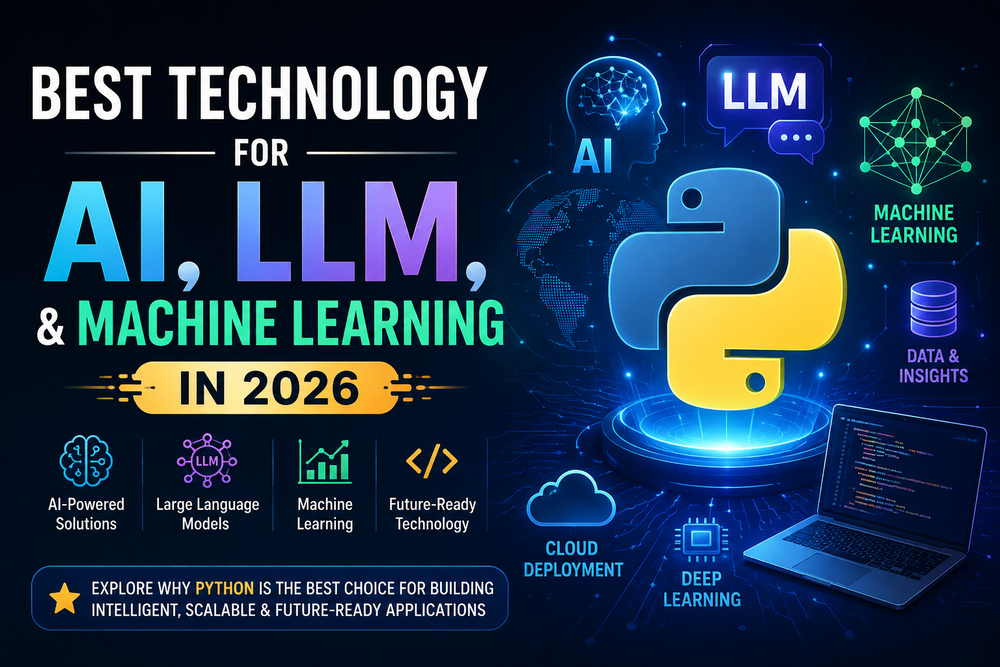
Artificial Intelligence (AI), Large Language Models (LLMs), and Machine Learning (ML) are changing the way modern software applications are built. From AI chatbots and recommendation systems to intelligent automation, computer vision, and generative AI, businesses are increasingly adopting AI-powered technologies.
But with so many programming languages, frameworks, platforms, and tools available, one important question comes up:
What is the best technology for AI, LLM, and Machine Learning in 2026?
For most AI and ML development use cases, Python remains one of the best technology choices because of its simple syntax, powerful libraries, mature ecosystem, research adoption, and extensive support for modern AI frameworks.
In this article, we will explore why Python is widely used for AI, LLM, and Machine Learning, what technologies are commonly used with Python, and how you can build modern AI applications using the Python ecosystem.
What Is the Best Technology for AI, LLM, and Machine Learning?
If you are looking for a single technology to start developing AI, LLM, and Machine Learning applications, Python is one of the strongest choices in 2026.
Python is widely used across the complete AI development lifecycle, including:
- Data processing
- Data analysis
- Machine Learning
- Deep Learning
- Natural Language Processing
- Large Language Models
- Generative AI
- Retrieval-Augmented Generation (RAG)
- AI agents
- Computer vision
- Model training
- Model evaluation
- AI APIs and backend services
However, modern AI applications are rarely built using only one technology.
A typical AI stack may look like:
Application
     ↓
Python Backend
     ↓
AI / ML Framework
     ↓
LLM / ML Model
     ↓
Vector Database / Database
     ↓
GPU / Cloud Infrastructure
Python acts as the central development language while other technologies provide specialized capabilities.
Why Is Python One of the Best Technologies for AI?
Python's popularity in AI is not accidental.
The language provides a combination of simplicity, flexibility, libraries, frameworks, community support, and research adoption that makes AI development significantly easier.
Let's look at the main reasons.
1. Python Has Simple and Readable Syntax
AI development can already be complicated.
Developers may need to work with:
- Neural networks
- Embeddings
- Transformers
- Datasets
- Mathematical operations
- Model parameters
- Training pipelines
- Inference
- Vector databases
Python has a relatively simple syntax, allowing developers to focus on solving AI problems rather than dealing with complicated language syntax.
For example, loading and analyzing a dataset can be done with just a few lines:
import pandas as pd

data = pd.read_csv("dataset.csv")

print(data.head())
This simplicity makes Python useful for both beginners and experienced AI engineers.
2. Python Has a Huge AI and Machine Learning Ecosystem
One of Python's biggest advantages is its ecosystem.
There are mature libraries and frameworks available for almost every stage of AI development.
Some popular technologies include:
| Technology | Main Use |
|---|---|
| NumPy | Numerical computing |
| Pandas | Data processing |
| Scikit-learn | Machine Learning |
| PyTorch | Deep Learning |
| TensorFlow | Machine Learning and Deep Learning |
| Transformers | LLMs and NLP |
| OpenCV | Computer Vision |
| XGBoost | Machine Learning |
| LangChain | LLM applications |
| LlamaIndex | LLM data and RAG applications |
Instead of building everything from scratch, developers can combine existing tools to create powerful AI applications.
3. Python Is Widely Used for Machine Learning
Machine Learning involves much more than training a model.
A complete ML workflow usually includes:
Data Collection
      ↓
Data Cleaning
      ↓
Data Processing
      ↓
Feature Engineering
      ↓
Model Training
      ↓
Model Evaluation
      ↓
Model Deployment
      ↓
Model Monitoring
Python provides tools for almost every stage of this workflow.
For example, Scikit-learn can be used to train traditional Machine Learning models.
from sklearn.linear_model import LinearRegression

model = LinearRegression()

model.fit(X_train, y_train)

predictions = model.predict(X_test)
For more advanced Deep Learning workloads, frameworks such as PyTorch and TensorFlow can be used.
4. Python Is a Major Language for Large Language Models
Large Language Models have become one of the biggest areas of AI development.
LLMs power applications such as:
- AI chatbots
- Coding assistants
- AI search
- Document analysis
- Content generation
- Customer support
- Summarization
- Question answering
- AI agents
Python provides a strong ecosystem for building these applications.
Developers can use Python to interact with LLM APIs, open-source models, embedding models, vector databases, and AI frameworks.
A typical LLM application can look like:
User
 ↓
Python Application
 ↓
Prompt Processing
 ↓
LLM
 ↓
Response Processing
 ↓
Application
This makes Python an excellent choice for developers who want to build LLM-powered products.
5. Python Is Excellent for Generative AI
Generative AI allows applications to generate new content such as:
- Text
- Images
- Audio
- Video
- Code
Python is heavily used for experimenting with and integrating generative AI technologies.
A Python application can connect:
User
 ↓
Python API
 ↓
Prompt / Input Processing
 ↓
Generative AI Model
 ↓
Output Processing
 ↓
User
This architecture can be used to build everything from simple AI assistants to complex enterprise applications.
6. Python Is a Strong Choice for RAG Applications
Retrieval-Augmented Generation, commonly known as RAG, has become an important architecture for AI applications.
RAG allows an LLM to retrieve relevant information from an external knowledge source before generating an answer.
For example, imagine an organization has thousands of internal documents.
Instead of expecting an LLM to already know all of that information, a RAG system can retrieve the relevant documents and provide them to the model.
A typical RAG architecture looks like:
Documents
    ↓
Text Extraction
    ↓
Chunking
    ↓
Embeddings
    ↓
Vector Database
    ↓
User Query
    ↓
Similarity Search
    ↓
Relevant Context
    ↓
LLM
    ↓
Answer
Python has a strong ecosystem for implementing these workflows.
RAG applications can be built using combinations of:
- Python
- LLM APIs
- Embedding models
- Vector databases
- Document processing libraries
- Retrieval frameworks
This is one of the reasons Python remains important in modern AI development.
7. Python Works With Popular Deep Learning Frameworks
Deep Learning is a major component of modern AI.
Frameworks such as PyTorch and TensorFlow allow developers and researchers to build neural networks and train complex models.
A simple PyTorch example looks like:
import torch
import torch.nn as nn

class NeuralNetwork(nn.Module):

    def __init__(self):
        super().__init__()
        self.layer = nn.Linear(10, 2)

    def forward(self, x):
        return self.layer(x)

model = NeuralNetwork()
The same ecosystem can be used for much more complex AI architectures.
Examples include:
- Transformers
- Convolutional Neural Networks
- Recurrent Neural Networks
- Diffusion models
- Vision models
- Speech models
- Multimodal models
8. Python Can Use GPU Acceleration
Modern AI models can require significant computational resources.
GPUs are commonly used to accelerate AI workloads.
Python frameworks such as PyTorch provide GPU support.
For example:
device = "cuda" if torch.cuda.is_available() else "cpu"

model = model.to(device)
This allows developers to run models on supported GPUs while maintaining a Python-based development workflow.
The heavy numerical computation is generally handled by optimized underlying libraries and GPU kernels.
Therefore, Python does not need to perform every computation directly.
9. Python Is Strongly Connected to AI Research
Another major advantage of Python is its role in AI research.
Researchers commonly use Python for:
- Experiments
- Model development
- Dataset analysis
- Training
- Evaluation
- Visualization
- Benchmarking
- Prototyping
When new AI techniques are introduced, Python implementations are often available through open-source libraries and research projects.
This creates a useful path:
AI Research
     ↓
Python Implementation
     ↓
Experimentation
     ↓
Prototype
     ↓
Production Application
Developers can therefore move relatively quickly from research concepts to working prototypes.
10. Python Makes AI Prototyping Faster
AI development usually involves experimentation.
You may need to test:
- Multiple LLMs
- Different prompts
- Different embedding models
- Different datasets
- Different ML algorithms
- Different retrieval methods
- Different model parameters
Python makes it relatively easy to create and modify prototypes.
For example, an AI team can quickly build a proof of concept before investing heavily in production infrastructure.
This is especially valuable for startups and teams that need to validate an AI idea quickly.
Python vs Other Technologies for AI
Although Python is one of the best choices for AI, it is important to understand that Python is not the only technology used in AI development.
Different languages have different strengths.
Python
Best suited for:
- AI development
- Machine Learning
- Deep Learning
- LLM applications
- Data science
- AI research
- RAG
- AI agents
- Prototyping
C++
C++ is useful for:
- High-performance systems
- Low-level AI infrastructure
- Optimized inference
- Embedded AI
- Performance-critical workloads
JavaScript / TypeScript
JavaScript and TypeScript are useful for:
- AI-powered web applications
- Frontend AI features
- Full-stack applications
- Browser-based AI
- API integrations
Java
Java can be useful for:
- Enterprise applications
- Large backend systems
- Organizations with existing Java infrastructure
Rust
Rust is increasingly useful for:
- High-performance infrastructure
- Systems programming
- Efficient backend services
- Performance-sensitive AI components
The best technology therefore depends on the problem you are solving.
However, for the overall AI, ML, and LLM development ecosystem, Python remains one of the strongest choices.
Best Python Technologies for AI, LLM, and ML
If you are planning to learn Python for AI, you should also understand the major technologies around it.
NumPy
NumPy provides tools for numerical computing and is widely used as a foundation for scientific and data-oriented Python applications.
It is useful for working with:
- Arrays
- Matrices
- Numerical operations
- Mathematical calculations
Pandas
Pandas is commonly used for data manipulation and analysis.
It is useful for:
- Loading datasets
- Cleaning data
- Filtering data
- Transforming data
- Data analysis
Example:
import pandas as pd

df = pd.read_csv("data.csv")

df = df.dropna()

print(df.describe())
Scikit-learn
Scikit-learn is one of the most popular libraries for traditional Machine Learning.
It supports algorithms such as:
- Linear regression
- Logistic regression
- Decision trees
- Random forests
- Clustering
- Classification
- Regression
It is an excellent starting point for learning Machine Learning.
PyTorch
PyTorch is a major Deep Learning framework.
It is commonly used for:
- Neural networks
- Deep Learning
- Computer vision
- NLP
- Model training
- Research
- AI experimentation
It is particularly important for developers working with modern Deep Learning and LLM technologies.
TensorFlow
TensorFlow is another major Machine Learning and Deep Learning framework.
It provides tools for:
- Model development
- Training
- Deployment
- Production ML systems
Organizations may choose PyTorch, TensorFlow, or other frameworks depending on their requirements.
Transformers
Transformer-based architectures are at the heart of many modern language models.
The Python ecosystem provides tools for working with:
- Pre-trained models
- Tokenizers
- Text classification
- Text generation
- Embeddings
- Fine-tuning
- NLP tasks
This makes the Python ecosystem highly relevant for LLM development.
Python and AI Agents
AI agents are becoming an important application of LLM technology.
An AI agent can combine an LLM with tools, memory, APIs, databases, and external systems.
For example:
User
 ↓
AI Agent
 ↓
LLM
 ├── Database
 ├── Search
 ├── APIs
 ├── Calculator
 └── External Tools
 ↓
Final Response
Python is well suited to this type of application because it can easily connect different APIs, databases, tools, and AI models.
This makes it useful for building intelligent automation systems.
Python for Computer Vision
AI is not limited to text and LLMs.
Computer Vision is another major field where Python is widely used.
Python applications can process:
- Images
- Videos
- Camera streams
- Object detection
- Face detection
- Image classification
- OCR
Libraries such as OpenCV and Deep Learning frameworks provide tools for building computer vision applications.
A basic computer vision workflow can look like:
Camera / Image
      ↓
Python
      ↓
Image Processing
      ↓
AI Model
      ↓
Prediction
      ↓
Application
Python for AI APIs and Backend Development
Building an AI model is only one part of creating an AI product.
The model needs to be connected to an application.
Python can be used to build APIs and backend services that expose AI functionality to web and mobile applications.
For example:
Web Application
      ↓
REST API
      ↓
Python Backend
      ↓
AI Model
      ↓
Database / Vector Database
Frameworks such as FastAPI and Flask can be used to create these backend services.
This allows developers to build complete AI-powered applications rather than only AI experiments.
Is Python the Best Programming Language for AI?
For many AI use cases, Python is one of the best programming languages available.
However, there is no single programming language that is best for every AI project.
Python is particularly strong because it provides:
- A mature AI ecosystem
- Extensive ML libraries
- Deep Learning frameworks
- LLM tooling
- Data science libraries
- Research support
- Fast prototyping
- Large community support
For performance-critical components, other languages such as C++, Rust, or specialized GPU technologies may be used alongside Python.
Therefore, a realistic modern AI stack is often not:
Python Only
but:
Python
   +
AI Frameworks
   +
GPU Technologies
   +
Databases
   +
Cloud Infrastructure
What Should You Learn to Become an AI Developer?
If your goal is to become an AI developer, learning Python is a strong starting point.
A practical learning path could be:
Step 1: Learn Python
Understand:
- Variables
- Functions
- Classes
- Modules
- Exceptions
- File handling
- APIs
- Virtual environments
Step 2: Learn Data Processing
Learn:
- NumPy
- Pandas
- Data cleaning
- Data visualization
Step 3: Learn Machine Learning
Study:
- Regression
- Classification
- Clustering
- Feature engineering
- Model evaluation
Step 4: Learn Deep Learning
Learn:
- Neural networks
- PyTorch or TensorFlow
- Training
- Validation
- GPU usage
Step 5: Learn LLMs
Understand:
- Transformers
- Tokens
- Embeddings
- Prompt engineering
- LLM APIs
- Open-source models
Step 6: Learn RAG
Understand:
- Document processing
- Chunking
- Embeddings
- Vector databases
- Retrieval
- Context generation
Step 7: Build AI Applications
Finally, combine everything into real applications.
For example:
Python
  ↓
FastAPI
  ↓
LLM
  ↓
RAG
  ↓
Vector Database
  ↓
Frontend
This gives you practical experience with the modern AI application stack.
What Is the Best Technology Stack for AI in 2026?
There is no universal technology stack that is best for every project.
However, a common AI application architecture can include:
| Layer | Example Technologies |
|---|---|
| Programming | Python |
| API / Backend | FastAPI / Flask |
| Machine Learning | Scikit-learn |
| Deep Learning | PyTorch / TensorFlow |
| LLM | Hosted or open-source models |
| Embeddings | Embedding models |
| Vector Search | Vector database |
| Database | PostgreSQL / NoSQL databases |
| Frontend | React / Next.js |
| Deployment | Docker / Cloud infrastructure |
| GPU | CUDA-compatible infrastructure |
The exact stack should be selected based on the application's requirements, scale, performance, cost, and deployment environment.
Why Python Will Continue to Be Important for AI
The AI ecosystem is changing rapidly.
New models, frameworks, libraries, and AI architectures are introduced regularly.
But Python has an important advantage: it already sits at the center of a large part of the AI ecosystem.
Developers can move between:
Machine Learning
       ↓
Deep Learning
       ↓
LLMs
       ↓
RAG
       ↓
AI Agents
       ↓
AI Applications
without needing to completely change their development environment.
Python's ecosystem also makes it easier to integrate new technologies as they become available.
Frequently Asked Questions
What is the best technology for AI in 2026?
Python is one of the best technology choices for AI development in 2026 because of its large ecosystem, Machine Learning libraries, Deep Learning frameworks, LLM support, and extensive community.
What is the best programming language for Machine Learning?
Python is one of the most widely used programming languages for Machine Learning because libraries such as Scikit-learn, PyTorch, and TensorFlow provide extensive ML capabilities.
Is Python good for LLM development?
Yes. Python has a strong ecosystem for working with LLMs, including model libraries, APIs, embeddings, RAG frameworks, and AI application tooling.
Is Python required for AI?
No. AI can be developed using other programming languages such as C++, Java, JavaScript, and Rust. However, Python is one of the most accessible and widely adopted choices for AI and ML development.
Is Python better than C++ for AI?
It depends on the task. Python is generally preferred for AI research, Machine Learning, experimentation, and application development, while C++ can be valuable for performance-critical and low-level AI systems.
What should I learn first for AI?
Python is a strong starting point. After learning Python fundamentals, you can move into NumPy, Pandas, Machine Learning, Deep Learning, LLMs, RAG, and AI application development.
What is the best technology for building LLM applications?
Python is one of the strongest choices because it provides extensive support for LLM APIs, model libraries, embeddings, vector databases, RAG frameworks, and AI application development.
Final Thoughts
So, what is the best technology for AI, LLM, and Machine Learning in 2026?
There is no single technology that solves every AI problem.
However, if you want one programming language that provides a powerful combination of simplicity, flexibility, libraries, frameworks, research support, and AI tooling, Python is one of the strongest choices.
Python can be used across the AI development lifecycle:
Data
 ↓
Machine Learning
 ↓
Deep Learning
 ↓
LLMs
 ↓
RAG
 ↓
AI Agents
 ↓
AI APIs
 ↓
Production Applications
That broad ecosystem is what makes Python so valuable.
Whether you are a beginner starting your AI journey, a developer building an LLM application, or a company developing a production AI platform, learning Python can provide a strong foundation for working with modern AI technologies.
In 2026, Python remains one of the best technology choices for building AI, LLM, and Machine Learning applications.