Monolith vs Microservices (When Each Makes Sense)
Monolith vs microservices is not about trends, it’s about context. Know how each architecture works, the trade-offs and when to use them depending on the size of your project, team and scalability needs.

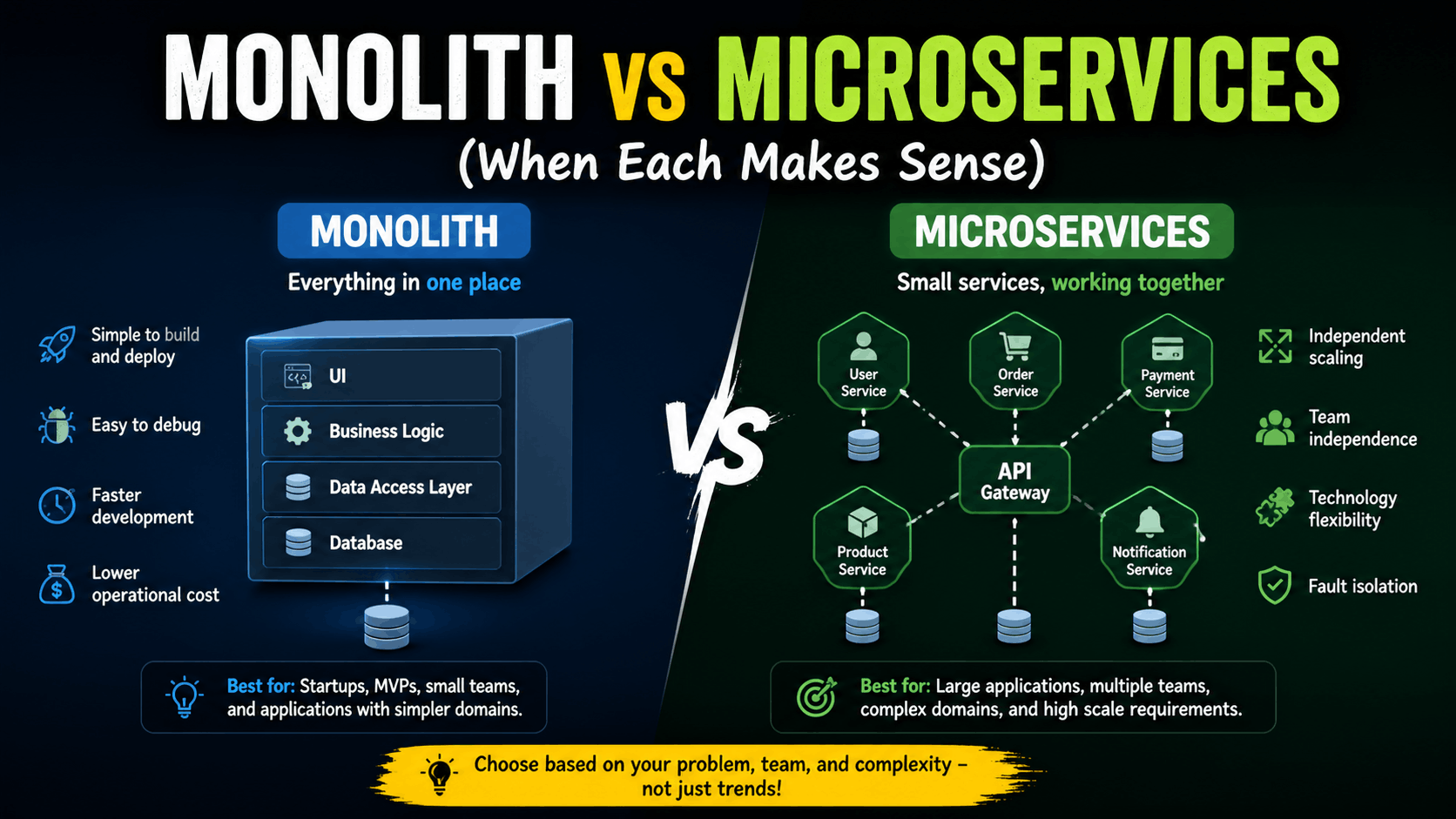
A practical, experience-driven guide to choosing the right architecture
Introduction: The Architecture Decision That Everyone Overcomplicates
At some point in your journey as a developer, you’ll run into this question:
“Should I build this as a monolith or microservices?”
And if you search online, you’ll get:
- Diagrams with arrows everywhere
- Complex terms like “distributed systems”
- Strong opinions with no context
The result?
Confusion.
Here’s the truth most people don’t say clearly:
This is not a technical decision first.
It’s a context decision.
In this blog, we’re going to strip away the noise and answer one simple question:
When does each approach actually make sense?
What Is a Monolith (In Plain Terms)
A monolith is a single application where everything lives together.
- One codebase
- One deployment
- One backend
Example:
- Your API routes
- Business logic
- Database access
All inside one project.
Simple Structure Example:
src/
 ├── controllers/
 ├── services/
 ├── models/
 ├── routes/
 └── app.ts
Everything is connected. Everything runs together.
Why Monoliths Are Actually Great
Let’s kill the myth first:
Monolith is not bad.
In fact, for most projects, it’s the best starting point.
1. Simple to Build
You don’t need:
- Multiple services
- Service communication
- Deployment pipelines
You just build and run.
2. Easy to Debug
If something breaks:
- You trace it in one codebase
- No network issues
- No service boundaries
Debugging is faster.
3. Faster Development
You can:
- Move quickly
- Change anything
- Deploy instantly
Perfect for:
- Startups
- MVPs
- Personal projects
4. Lower Operational Cost
No need for:
- Multiple servers
- Complex infra
- Service orchestration
Where Monolith Starts Breaking
Monolith works… until it doesn’t.
Here’s where problems begin:
1. Codebase Becomes Huge
- Hard to navigate
- Hard to maintain
- New developers struggle
2. Tight Coupling
Changing one thing:
- Breaks another
- Causes side effects
3. Scaling Limitations
You can’t scale parts independently.
Example:
- Only your “orders” module needs scaling
- But you scale the entire app
4. Slower Deployment
As app grows:
- Build time increases
- Risk increases
- Small change → full deploy
What Are Microservices (Without the Buzzwords)
Microservices break your app into smaller, independent services.
Each service:
- Has its own logic
- Can have its own database
- Can be deployed independently
Example:
- Auth Service
- Product Service
- Order Service
Each runs separately.
Why Microservices Sound So Attractive
On paper, microservices look perfect.
1. Independent Scaling
You scale only what needs scaling.
2. Team Independence
Different teams:
- Work on different services
- Deploy independently
3. Better Separation of Concerns
Each service:
- Does one thing
- Is easier to reason about
The Reality of Microservices (This Is Where People Get It Wrong)
Microservices are not “better.”
They are more complex.
1. Communication Overhead
Services talk via:
- HTTP
- Message queues
Now you deal with:
- Network failures
- Latency
- Retry logic
2. Debugging Becomes Hard
A single request might go through:
- 3–5 services
Tracking bugs becomes painful.
3. Deployment Complexity
You now manage:
- Multiple services
- CI/CD pipelines
- Versioning
4. Data Consistency Problems
Each service may have:
- Its own database
Now:
- Transactions become tricky
- Sync issues appear
Monolith vs Microservices (Simple Comparison)
| Factor | Monolith | Microservices |
|---|---|---|
| Setup | Simple | Complex |
| Deployment | Single | Multiple |
| Debugging | Easy | Difficult |
| Scaling | Limited | Flexible |
| Team Size | Small teams | Large teams |
| Performance | Good (internal calls) | Network overhead |
When You Should Use a Monolith
Use a monolith if:
- You’re building an MVP
- You’re a solo developer or small team
- Your app is still evolving
- You want fast development
- You don’t have complex scaling needs
👉 This is where most projects should start.
When Microservices Actually Make Sense
Use microservices if:
- Your app is large and growing fast
- You have multiple teams
- Different parts need independent scaling
- Your system has clear domain boundaries
- You can handle infrastructure complexity
👉 Notice: This is not beginner territory.
The Biggest Mistake Developers Make
They start with microservices too early.
Why?
Because it looks:
- Scalable
- Modern
- “Industry-level”
But in reality:
They end up:
- Slower
- More confused
- Managing complexity instead of building features
A Better Approach (That Actually Works)
Start simple.
Step 1: Build a Monolith
- Move fast
- Validate idea
- Keep structure clean
Step 2: Modularize Internally
- Separate logic into modules
- Keep boundaries clear
Step 3: Extract Services Later
Only when needed:
- High traffic
- Scaling issues
- Team growth
Real Example (Simple Scenario)
Let’s say you’re building an e-commerce app.
Start:
Monolith:
- Auth
- Products
- Orders
- Payments
All in one app.
Later (when scaling needed):
Split:
- Auth → separate service
- Orders → separate service
Now you have controlled microservices.
Final Thoughts
Monolith vs Microservices is not about:
“What’s better?”
It’s about:
“What’s right for your current stage?”
Most developers overestimate their need for complexity.
The smartest move is not choosing the most advanced architecture.
It’s choosing the one that lets you
- Build faster
- Understand your system
- Scale when needed