How One Notification Can Hijack Your Entire Attention Span
One tiny notification can completely derail your focus by triggering curiosity, dopamine loops, and attention-switching inside the brain. This blog explores the hidden psychology and technology behind how modern apps are engineered to capture your attention.

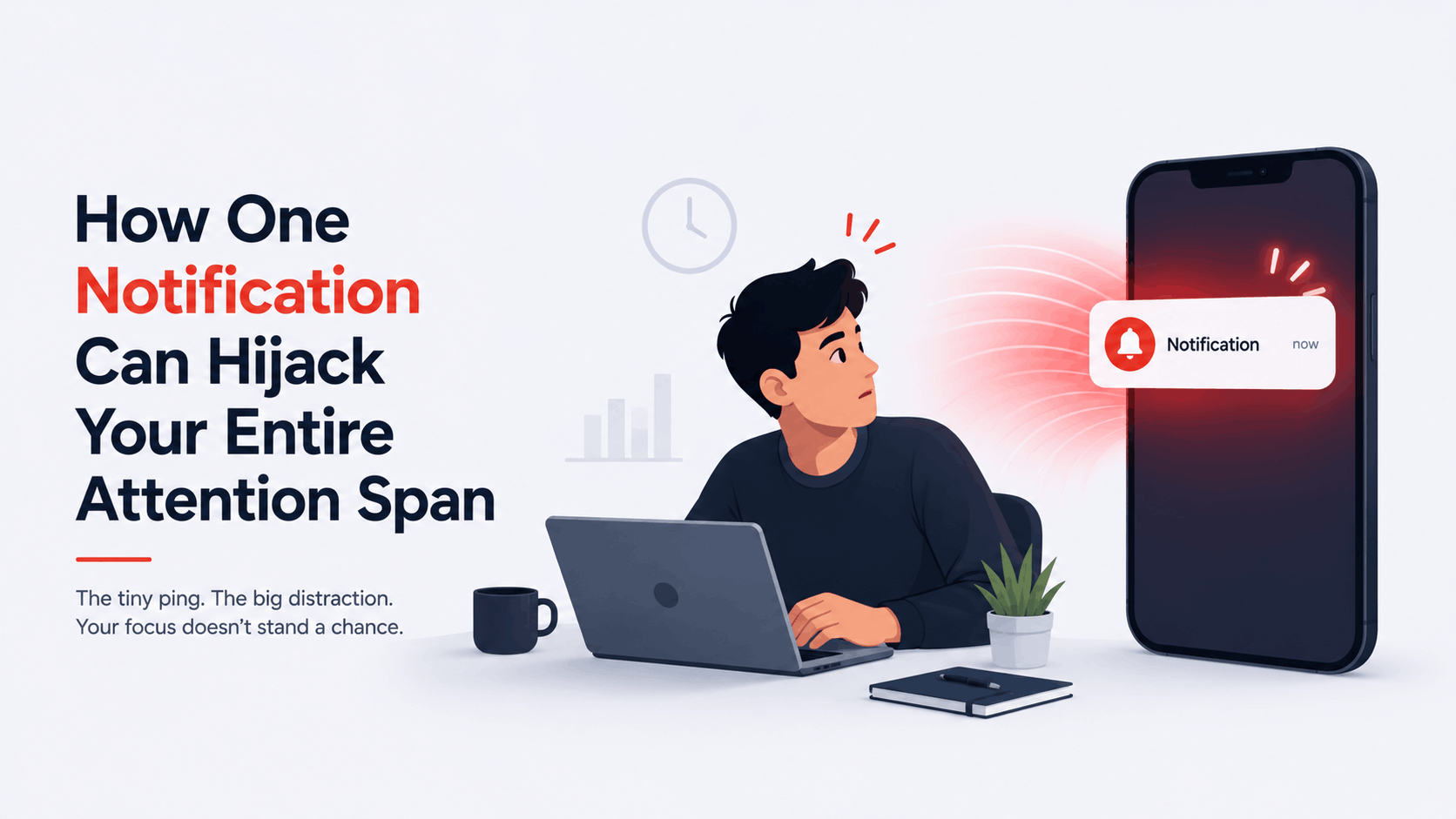
The hidden psychology, neuroscience, algorithms, and technology behind why a single notification can completely destroy your focus
Introduction: You Were Doing Fine… Until Your Phone Buzzed
You sit down to work.
Maybe:
- studying
- coding
- writing
- reading
- replying to emails
For a moment,
your brain finally feels focused.
Then suddenly:
Buzz.
A notification appears.
That’s it.
Maybe it’s:
- a message
- a meme
- an Instagram like
- a shopping alert
- a random “recommended for you” notification
You check it for “just two seconds.”
And somehow:
- you open another app
- watch a video
- reply to messages
- scroll social media
- forget what you were originally doing
Twenty minutes disappear.
Sometimes an hour.
And weirdly,
getting back into focus afterward feels harder than before.
Almost like your brain changed modes completely.
Because honestly?
It did.
Modern notifications are not just harmless digital reminders anymore.
They became highly optimized attention-triggering systems designed to interrupt human focus extremely effectively.
And behind every tiny notification exists a fascinating combination of:
- psychology
- neuroscience
- machine learning
- behavioral design
- engagement optimization
Working together constantly.
Notifications Used to Be Simple
Early notifications were mostly functional.
Your device notified you because:
- someone called
- important email arrived
- calendar reminder triggered
That’s it.
The goal was communication.
Not engagement.
Modern apps changed that dramatically.
Today, Notifications Compete for Attention
Modern apps don’t just notify users.
They compete aggressively for:
- screen time
- engagement
- attention
- interaction frequency
Because attention became business.
And notifications became one of the most powerful tools for capturing it.
Your Brain Treats Notifications Like Potentially Important Information
This is where psychology enters.
Humans evolved to respond quickly to:
- new information
- unexpected signals
- social cues
- uncertainty
Notifications exploit these instincts extremely well.
A buzz or sound immediately creates:
anticipation.
Your brain wants resolution.
Curiosity Is One of the Strongest Attention Triggers
The moment notification appears,
your brain asks:
“What is it?”
Even if logically you know:
“It’s probably unimportant.”
Curiosity itself creates mental tension.
Checking notification resolves that tension.
This becomes habit loop very quickly.
Notifications Interrupt More Than Time
Most people think distractions only cost:
a few seconds.
But attention switching is much more expensive cognitively.
When interrupted,
your brain must:
- stop current mental context
- process new information
- re-enter original task later
That transition itself consumes mental energy.
Your Brain Has “Focus Momentum”
Deep focus works somewhat like momentum.
The longer humans remain concentrated,
the deeper cognitive engagement becomes.
Notifications break that momentum instantly.
That’s why recovering focus often feels frustrating.
Example: The “Quick Check” Trap
Imagine John writing important report.
Phone buzzes.
He checks:
one meme from friend.
Then:
- replies quickly
- notices another message
- opens Instagram briefly
- watches short video
- checks notifications again
Suddenly:
35 minutes disappear.
The original interruption lasted seconds.
The attention shift lasted much longer.
Notifications Trigger Dopamine Loops
People often oversimplify dopamine online.
But reward systems genuinely matter here.
Notifications create:
- anticipation
- novelty
- social validation
- uncertainty
These are psychologically powerful stimuli.
Especially when rewards are unpredictable.
Why Random Notifications Feel More Addictive
If every notification were boring,
people would ignore them.
But sometimes notifications contain:
- exciting messages
- social validation
- important updates
- funny content
That unpredictability strengthens checking behavior.
The brain starts thinking:
“Maybe this notification is interesting.”
Social Media Platforms Optimized This Aggressively
Apps like:
- TikTok
- YouTube
Carefully optimize notification systems because:
notifications increase engagement enormously.
More notifications often mean:
- more app opens
- more scrolling
- more ad exposure
- more platform retention
Notification Timing Is Not Random
This part surprises many people.
Modern apps increasingly optimize:
when notifications appear.
Algorithms analyze:
- user activity patterns
- engagement timing
- sleep cycles
- app-opening habits
To maximize interaction probability.
AI Quietly Predicts When You’re Most Likely to Open Apps
Modern systems increasingly use machine learning for engagement prediction.
Apps may learn:
- when users feel bored
- when users check phones frequently
- when users respond fastest
This allows smarter notification timing.
That’s attention engineering.
Red Notification Badges Are Psychologically Powerful
Those tiny red circles?
Not accidental.
Red naturally attracts human attention because brains associate it with:
- urgency
- importance
- warning signals
UI designers understand this extremely well.
Tiny design decisions dramatically affect behavior.
Infinite Scrolling Makes Notifications More Dangerous
Notifications often pull users into apps designed around endless engagement.
Once inside,
algorithms continue optimizing retention through:
- infinite feeds
- recommendations
- autoplay content
The notification becomes entry point into much larger attention loop.
Your Attention Span Is Not Actually “Destroyed”
This matters.
Humans still can focus deeply.
The issue is constant interruption.
Modern digital environments continuously fragment attention through:
- notifications
- multitasking
- app switching
- endless stimulation
Focus becomes harder because interruption became constant.
Smartphones Quietly Changed Human Attention Patterns
Before smartphones,
people experienced more uninterrupted moments.
Now many people check phones:
- during meals
- while walking
- before sleeping
- after waking
- during conversations
Notifications normalized continuous interruption.
Phantom Vibrations Are a Real Thing
Many people feel:
phones vibrating when nothing happened.
That’s how deeply notification anticipation affects the brain.
Humans become conditioned to expect digital interruptions constantly.
That’s fascinating psychologically.
Notification Anxiety Became Common
People increasingly feel:
- anxious checking notifications
- anxious not checking notifications
- pressure to respond quickly
Communication became continuous.
And expectations changed with it.
Read Receipts Changed Social Pressure
Features like:
- typing indicators
- online status
- seen receipts
Quietly altered communication psychology.
People now expect faster replies because digital presence became visible.
Notifications intensified that pressure.
Productivity Apps Use Similar Psychology Too
Even “productive” apps increasingly compete for engagement.
Not every notification is manipulative.
But many apps optimize aggressively around retention metrics regardless of category.
Why Focus Feels Harder After Scrolling
After consuming rapid content,
the brain adapts temporarily to:
- fast stimulation
- novelty
- constant switching
Returning to slower tasks afterward feels mentally uncomfortable.
Attention requires adjustment time.
Multitasking Is Mostly Task-Switching
Humans rarely multitask effectively cognitively.
Most “multitasking” is actually rapid attention switching.
Notifications increase switching frequency dramatically.
That reduces mental efficiency.
Deep Work Became Harder in Digital Environments
Focused work increasingly requires intentional protection from interruption.
Because modern technology environments are optimized for:
- responsiveness
- engagement
- constant connectivity
Not necessarily concentration.
Companies Measure Notification Success Aggressively
Platforms analyze:
- open rates
- interaction timing
- engagement duration
- retention behavior
Notifications are heavily data-driven systems now.
Tiny experiments constantly optimize user response behavior.
AI May Make Notifications Even Smarter
Future systems may increasingly predict:
- mood
- emotional state
- boredom patterns
- stress levels
Notifications could become hyper-personalized attention triggers.
That future raises major ethical questions.
Why “Just Turning Off Notifications” Feels Surprisingly Difficult
Because notifications became socially integrated.
People fear:
- missing messages
- missing updates
- social disconnection
- delayed responses
The issue isn’t only technology.
It’s modern social behavior too.
Silence Became Uncomfortable for Many People
Constant stimulation changed expectations.
Many people instinctively reach for phones during:
- waiting
- boredom
- quiet moments
Notifications reinforce that habit continuously.
Tech Companies Quietly Study Human Attention Deeply
Modern apps increasingly combine:
- behavioral psychology
- machine learning
- interface design
- neuroscience insights
To optimize engagement systems.
Notifications are part of much larger attention economy infrastructure.
Attention Became One of the Most Valuable Resources Online
Modern internet business models depend heavily on:
- user engagement
- screen time
- retention
Because attention drives:
- advertising revenue
- recommendation systems
- platform growth
Notifications help sustain that economy.
Some Apps Are Trying Healthier Designs
Certain platforms introduced:
- notification summaries
- focus modes
- screen time controls
- quiet modes
These features attempt balancing engagement with user well-being.
But business incentives still strongly reward attention capture.
The Most Interesting Part
A notification seems tiny.
Just:
- sound
- vibration
- icon
- popup
But psychologically,
it can completely redirect human cognition.
That’s extraordinary influence for such small design element.
Modern Notifications Are Basically Behavioral Triggers
The systems are engineered around:
- interruption timing
- anticipation
- habit loops
- engagement probability
Not because companies are necessarily evil.
But because attention became measurable,
optimizable,
and profitable.
Final Thoughts
One notification can hijack attention because modern digital systems became extremely good at triggering human curiosity and interruption patterns.
Behind every buzz may exist:
- behavioral analytics
- machine learning
- engagement prediction
- UI psychology
- retention optimization
Working together continuously.
Notifications are no longer simple alerts.
They became sophisticated attention-delivery systems built for the modern internet economy.
And most people barely notice how powerful they actually are.