What is an API? The ‘Waiter at a Restaurant’ Analogy
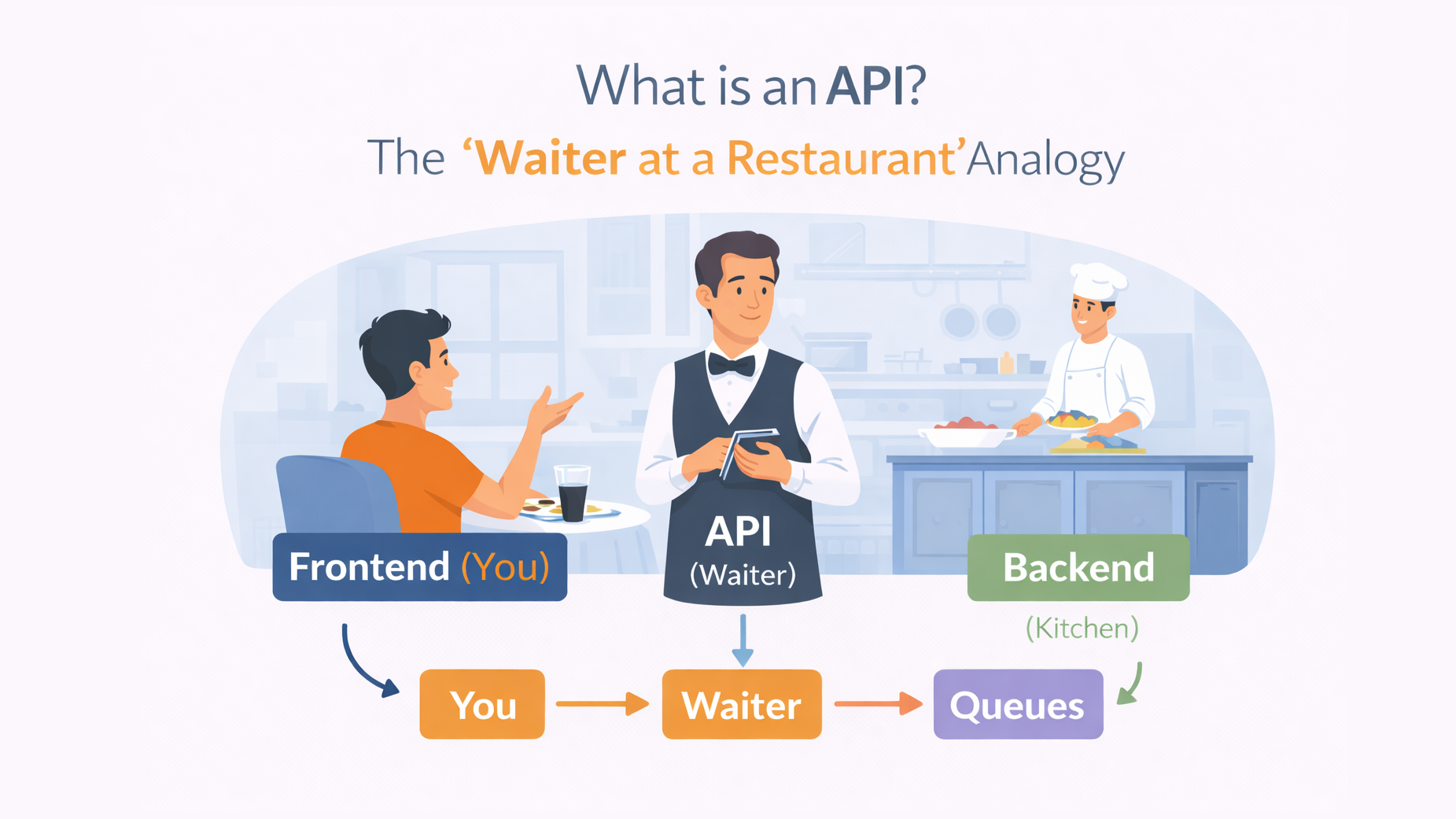
APIs can sound complicated — especially if you are new to programming.
Terms like:
- REST API
- GraphQL
- Endpoints
- JSON
- Requests and Responses
…can be overwhelming.
So let’s understand what an API really is using a simple, real-world analogy: a restaurant and a waiter.
🔹 The Real-World Problem
Imagine you go to a restaurant.
There are three main people involved:
- You (the customer)
- The Waiter
- The Kitchen (chef)
You do not go directly into the kitchen to cook your food.
Instead, you talk to the waiter.
This is exactly how APIs work in software.
🔹 The Analogy: Restaurant = API System
| Restaurant Role | Software Role |
|---|---|
| You | Frontend (Website / App) |
| Waiter | API |
| Kitchen | Backend / Server |
| Menu | API Documentation |
🔹 Step-by-Step Flow
Step 1 — You place an order
You tell the waiter:
“I want a pizza and coke.”
In software terms, this is like your frontend making a request:
GET /food/pizza
Step 2 — The waiter communicates with the kitchen
The waiter takes your order to the kitchen.
You don’t talk directly to the chef.
Similarly:
Your website does not talk directly to the database — it talks to an API.
Step 3 — The kitchen prepares food
The chef prepares your order and gives it to the waiter.
In software:
- The backend processes your request
- Fetches data from the database
- Prepares a response
Step 4 — The waiter returns the food
The waiter brings your pizza back to you.
In software:
- The API sends data back to the frontend
Example JSON response:
{
  "food": "Pizza",
  "drink": "Coke",
  "status": "ready"
}
Your website then displays it to the user.
🔹 So… What is an API?
In simple words:
An API is like a waiter that helps your frontend talk to the backend.\
More formally:
An API (Application Programming Interface) is a bridge that allows two software systems to communicate.
🔹 Where do we use APIs in real life?
You use APIs every day without realizing it:
- Logging in with Google
- Fetching Instagram posts
- Getting weather data
- Booking a cab
- Making online payments
All of these use APIs behind the scenes.
🔹 Types of APIs (Very Simple)
1. REST API
Like ordering different items from a menu using URLs.
GET /users
POST /login
GET /products
2. GraphQL
Like telling the waiter exactly what you want in one request.
🔹 Why APIs are Important
APIs allow:
- Frontend and backend to stay separate
- Different apps to talk to each other
- Scalability
- Code reuse
- Better architecture
🔹 Conclusion
APIs are not scary.
They are just messengers — like a waiter in a restaurant.
Whenever you hear “API”, think:
“Oh, that’s just the waiter between frontend and backend.”