JavaScript Variables Explained: The Difference Between let, const and var
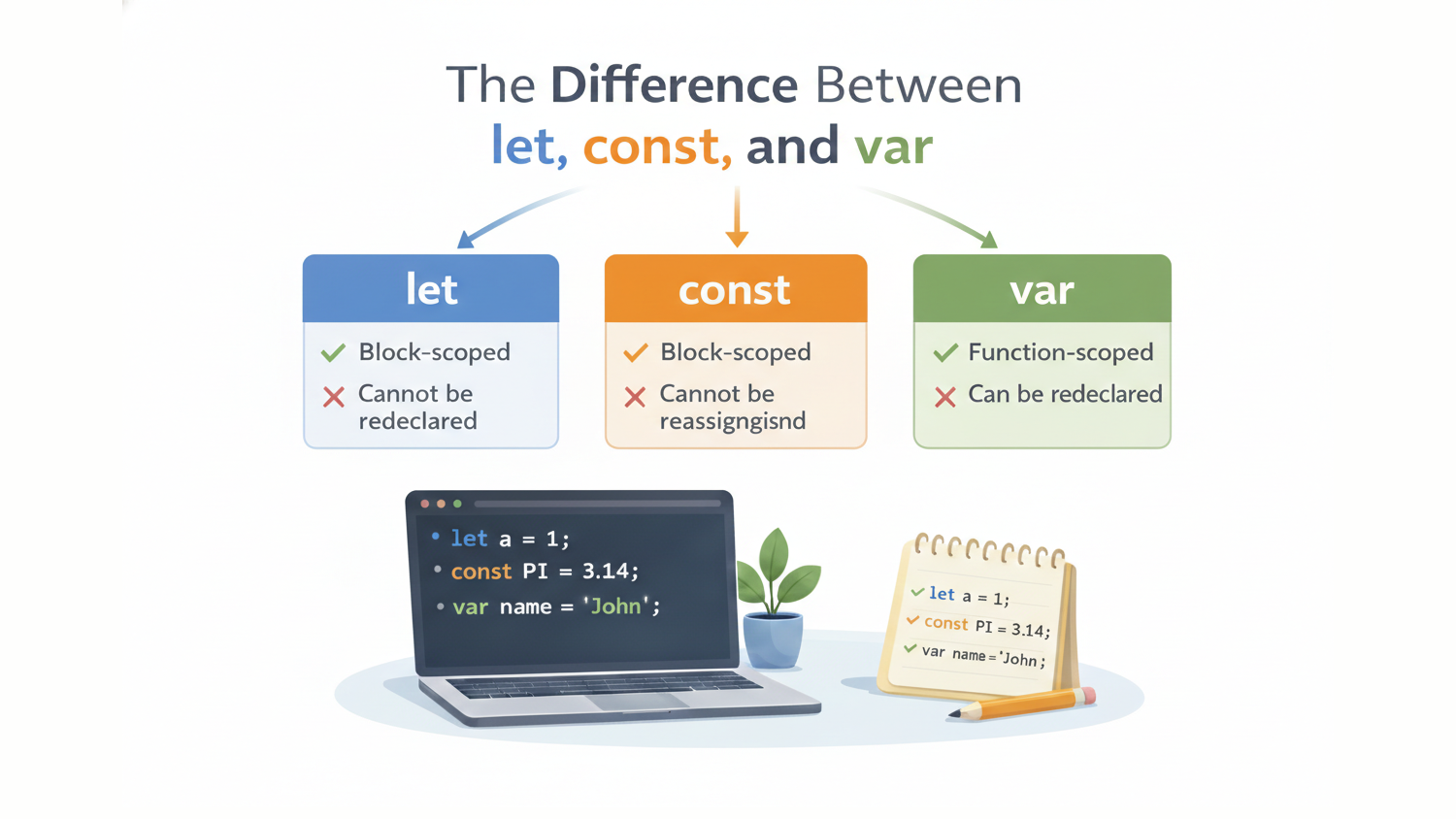
In JavaScript, variables are used to store data.
But there are three different ways to declare variables:
varletconst
They look similar… but they behave very differently.
Let’s break it down clearly.
🔹 What is a Variable?
A variable is a container that stores a value.
Example:
let name = "Codex Cider";Here:
nameis the variable"Codex Cider"is the value
🔹 1. var (The Old Way)
var was the original way to declare variables in JavaScript.
Example:
var age = 20;
Problems with var
- Function scoped (not block scoped)
- Can be redeclared
- Can be updated
- Hoisted in a confusing way
Example
if (true) {
  var x = 10;
}

console.log(x); // 10
Output: 10Even though x is inside the block, it is still accessible outside.
This can cause bugs.
🔹 2️. let (Modern and Safer)
let was introduced in ES6.
let count = 5;
Features of let
- Block scoped ✅
- Can be updated ✅
- Cannot be redeclared ❌
- Safer than var ✅
Example
if (true) {
  let y = 20;
}

console.log(y); // Error
Error: y is not defined🔹 3️. const (Constant Variable)
const is used for values that should not change.
const pi = 3.14;
Features of const
- Block scoped ✅
- Cannot be updated ❌
- Cannot be redeclared ❌
- Must be initialized immediately ✅
Example
const score = 100;
score = 200; // Error
Error: Assignment to constant variable.🔹 Important Note About const
With objects:
const user = { name: "John" };
user.name = "Mike"; // Allowed
You cannot reassign the variable —
but you can modify the object inside it.
🔹 Hoisting Difference
var
console.log(a);
var a = 5;
Output:
undefined
let and const
console.log(b);
let b = 10;
Output:
ReferenceError
This happens because of something called the Temporal Dead Zone (TDZ).
🔹 Quick Comparison Table
| Feature | var | let | const |
|---|---|---|---|
| Scope | Function | Block | Block |
| Redeclare | ✅ | ❌ | ❌ |
| Update | ✅ | ✅ | ❌ |
| Hoisted | Yes (undefined) | Yes (TDZ) | Yes (TDZ) |
| Modern Usage | ❌ Avoid | ✅ Yes | ✅ Yes |
🔹 When Should You Use Each?
✔ Use const by default
✔ Use let when value changes
❌ Avoid var in modern JavaScript
🔹 Best Practice Rule
Start withconst.
Switch toletonly if needed.
Simple and clean.
🔹 Conclusion
Understanding var, let, and const is essential for writing clean JavaScript.
var→ outdatedlet→ flexibleconst→ safest default
Modern JavaScript mostly uses:
const + let