How Generative AI Is Changing Frontend Engineering: From Components to Copilots
Generative AI isn’t just helping frontend engineers write code — it’s reshaping the entire role. From prompt design to AI-powered UI and streaming interfaces, discover how Gen-AI is transforming frontend engineering and what developers must learn to stay ahead.

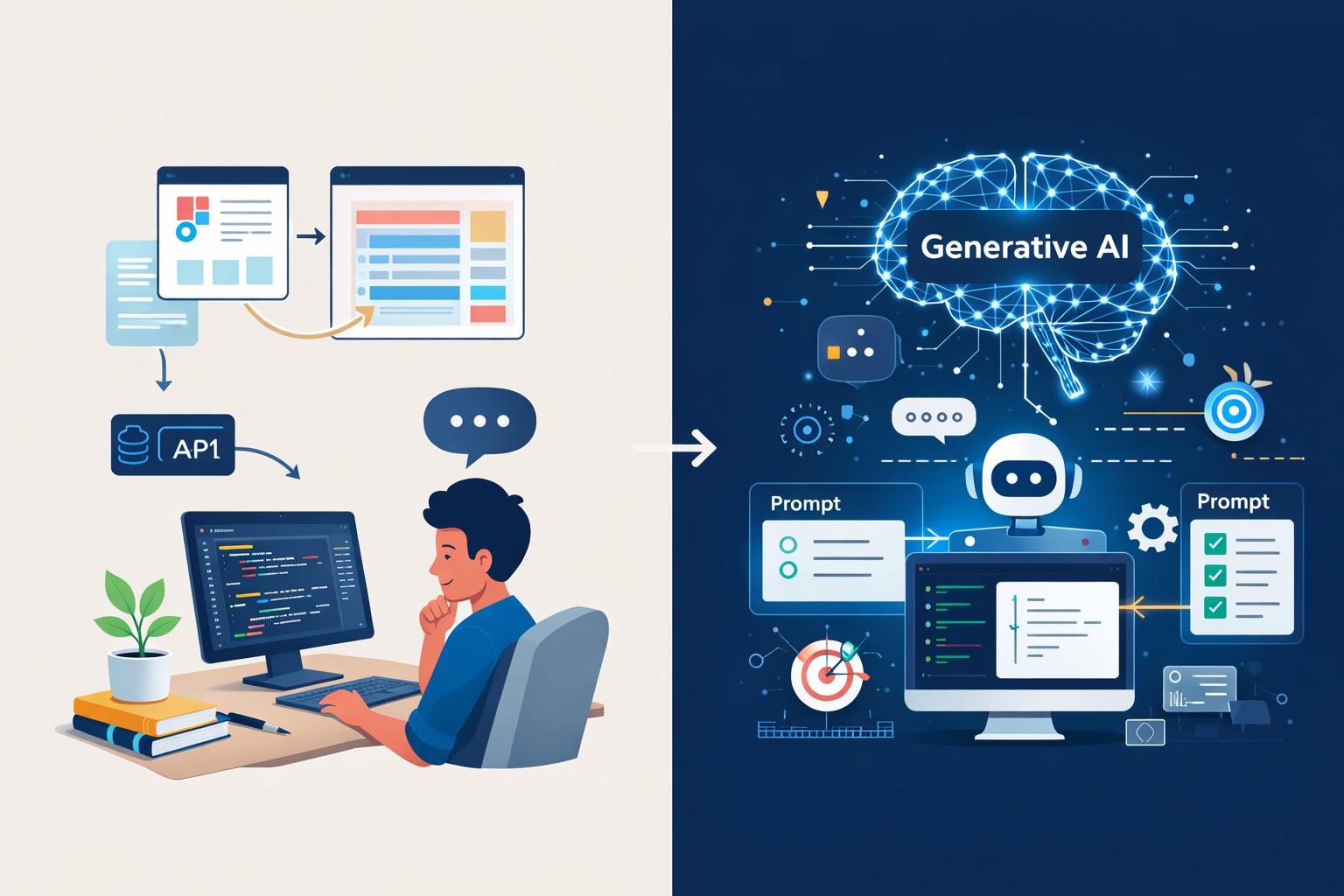
Frontend engineering used to be predictable.
You received a Figma design.
You wrote components.
You styled them.
You connected an API.
You debugged CSS at 2 AM because flexbox decided to betray you.
That was the job.
But something shifted.
Suddenly, frontend engineers are not just writing components anymore. They’re designing prompts. They’re validating AI outputs. They’re handling streaming responses. They’re thinking about hallucinations, token limits, and response schemas.
Generative AI didn’t just add a new tool to frontend development. It changed the shape of the job.
Let’s unpack what’s really happening.
And if you want to go deeper into how elite developers are using AI agents and vibe-driven workflows to move faster than ever, you’ll love my breakdown in Mastering Vibe Coding and AI Agents in 2026.
First, What Is Generative AI (In Simple Terms)?
Generative AI refers to systems that can generate content. Text, images, code, UI layouts, documentation — even entire components.
Large Language Models (LLMs) are a big part of this. They don’t “understand” like humans do. They predict the next word based on patterns learned from massive datasets. But when scaled, that prediction becomes shockingly powerful.
Instead of writing rules like traditional AI systems, generative AI creates outputs based on probability and context.
For frontend engineers, this means one thing:
You’re no longer just rendering static responses.
You’re rendering generated intelligence.
And that changes everything.
From Writing Code to Supervising Code
Let’s be honest. Many frontend engineers today use AI tools to generate code. You describe a component, and suddenly you have a full React function with hooks, styling, and even comments.
Example:
You type:
Create a React component for a pricing card with title, price, features list, and CTA button.
And the AI gives you something like:
function PricingCard({ title, price, features }) {
  return (
    <div className="card">
      <h2>{title}</h2>
      <p className="price">${price}</p>
      <ul>
        {features.map((f, i) => (
          <li key={i}>{f}</li>
        ))}
      </ul>
      <button>Get Started</button>
    </div>
  );
}
Ten years ago, this would feel like magic. Today, it’s normal.
But here’s the shift.
The real skill is no longer “Can you write this component?”
It’s “Can you evaluate, improve, secure, and integrate this component into a larger system?”
Generative AI speeds up typing. It does not replace architectural thinking.
Frontend engineers are slowly becoming code supervisors instead of pure code writers.
The UI Is No Longer Static
Traditional frontend flow looked like this:
User clicks a button → API returns structured JSON → UI renders predictable data.
Simple.
Now imagine this:
User types a prompt → LLM generates response → You validate output → You transform output → You render UI dynamically based on generated content.
This is not just fetching data. This is handling generated reasoning.
For example, suppose you’re building an AI-powered form builder. The user types:
Create a contact form for a SaaS startup with name, email, company size, and message field.
Instead of fetching a fixed schema from your backend, your frontend receives something like:
{
  "fields": [
    { "type": "text", "label": "Full Name" },
    { "type": "email", "label": "Email Address" },
    { "type": "select", "label": "Company Size" },
    { "type": "textarea", "label": "Message" }
  ]
}
Now your frontend must dynamically generate components based on AI output.
That means:
- Validating structure
- Preventing malformed responses
- Handling missing fields
- Guarding against hallucinated types
Frontend engineers are now building defensive systems against unpredictable intelligence.
Prompt Engineering Is Becoming a Frontend Skill
This is where things get interesting.
You used to worry about:
- CSS architecture
- Component composition
- Performance optimization
Now you also worry about:
- How you phrase system prompts
- How you constrain outputs
- How you enforce JSON schemas
- How you reduce hallucinations
For example, instead of asking:
Generate a product description.
You now ask:
Generate a product description in JSON format with fields: title (string), summary (string), and benefits (array of strings). Do not include any extra text.
Why?
Because frontend rendering depends on structure.
Generative AI forces frontend engineers to think like system designers. You are no longer just consuming APIs — you are shaping AI behavior.
Streaming UI Is the New Normal
Another big change is real-time streaming responses.
Instead of waiting for a full response, modern AI systems stream tokens progressively.
So your UI needs to handle:
- Partial responses
- Typing effects
- Loading states that feel alive
- Cancellation and retry logic
Imagine building a chat interface.
You don’t just show a spinner. You render text as it’s being generated. You maintain scroll state. You allow interruption.
This is not classic REST API UI anymore.
This is conversational UI engineering.
The Risk: Hallucinations in the Interface
Generative AI doesn’t just generate beautiful text. It sometimes generates confident nonsense.
If your frontend blindly trusts AI output, you risk showing incorrect information, broken UI layouts, or even unsafe content.
For example, suppose your AI generates a table schema:
{
  "columns": ["Name", "Revenue", "Growth Rate", "Unicorn Status"]
}
But your dataset doesn’t include “Unicorn Status”.
If your UI blindly renders it, your app breaks.
Frontend engineers must now validate and sanitize AI outputs before rendering them. That means adding logic layers between AI response and UI display.
We are not just rendering data anymore.
We are filtering intelligence.
The Rise of AI-Augmented UX
Generative AI also changes how users interact with interfaces.
Instead of clicking through menus, users type what they want.
Instead of navigating filters, they describe their needs.
For example, in a dashboard:
Old way:
User selects date range, category, region.
New way:
User types:
Show me revenue growth for SaaS companies in India for the last 2 years.
Now your frontend must:
- Send prompt to LLM.
- Convert natural language to structured query.
- Validate query.
- Fetch data.
- Render visualization.
This is not just UI development.
This is interaction orchestration.
Frontend engineers are becoming experience architects.
Will AI Replace Frontend Engineers?
This question always comes up.
Will generative AI write all UI code?
Yes, it will write repetitive components.
Yes, it will generate boilerplate.
Yes, it will assist with debugging.
But will it understand your product vision?
Will it optimize for business goals?
Will it design complex state flows?
Will it handle edge cases in real-world user behavior?
Not without you.
AI reduces friction.
It does not replace judgment.
The frontend engineer of the future is not someone who types fast. It’s someone who understands systems deeply and can integrate AI responsibly.
The Real Shift: From Builder to Orchestrator
This is the biggest change.
Frontend engineers are no longer just building UI.
They are orchestrating AI-driven systems.
They must understand:
- Prompt design
- Structured outputs
- Latency tradeoffs
- Cost per token
- Error recovery flows
- Human-AI interaction psychology
The job is evolving.
And honestly?
It’s getting more interesting.
Final Thoughts
Generative AI is not killing frontend engineering. It’s upgrading it.
It’s forcing engineers to think beyond components.
Beyond styling.
Beyond API calls.
It’s pushing frontend toward system-level thinking.
From components to copilots.
From static interfaces to intelligent experiences.
From rendering data to shaping intelligence.
The developers who adapt will not be replaced.
They’ll lead.
And the frontend will never be “just UI” again.